Today's
EarthStation1.com 15% Off Commemorative Memorial Title: Pioneers
Of Surgery Documentary TV Series DVD, MP4 Download, USB Drive
Today, November 4, 2025
November 4, 1847: Medicine: The History
Of Medicine: Surgery: The History Of Surgery: Anesthesia: The
History Of Anesthesia: -- The powerful anaesthetic properties of
chloroform, a colorless, strong-smelling, dense liquid, is
discovered by Scottish physician Sir James Young Simpson, a
discovery which helps to bring about a revolution in surgery. Also
known as trichloromethane, chloroform is a common organic solvent,
which when used as an anesthetic (American English) or anaesthetic
(British English) is a drug used to induce anesthesia, a state of
controlled, temporary loss of sensation or awareness that is
induced for medical and veterinary purposes. Sir James Young
Simpson, 1st Baronet, FRSE FRCPE FSA Scot (June 7, 1811 - May 6,
1870) was the first physician to demonstrate the anaesthetic
properties of chloroform on humans and helped to popularise its
use in medicine. On Sale @ 15% Off Discount Till Midnight PT!
https://store.earthstation1.com/pioneers-of-surgery-dvd-set-4-episode-tv-series-2-dis42.html
Today's
EarthStation1.com 15% Off Commemorative Memorial Title: Soldiers:
A History Of Men In Battle TV Series + Bonus Title DVD MP4
Today, November 4, 2025
November 4, 1862: Great Inventions:
Firearms: The History Of Firearms: Machine Guns: The History Of
Machine Guns: Rotary Machine Guns: The Gatling Gun: -- Inventor
Dr. Richard Jordan Gatling patents the Gatling gun, the first
successful machine gun, which used revolving barrels rotating
around a central mechanism to load, fire, and extract the
cartridges. Gatling wrote that he created it to reduce the size of
armies and so reduce the number of deaths by combat and disease,
and to show the futility of war. The US Army adopted Gatling guns
in several calibers, including .42 caliber, .45-70, .50 caliber, 1
inch, and (M1893 and later) .30 Army, with conversions of M1900
weapons to .30-03 and .30-06. The .45-70 weapon was also mounted
on some US Navy ships of the 1880s and 1890s. The Gatling gun was
first used in warfare during the American Civil War. Twelve of the
guns were purchased personally by Union commanders and used in the
trenches during the Siege of Petersburg, Virginia (June 1864-April
1865). Eight other Gatling guns were fitted on gunboats. The gun
was not accepted by the American Army until 1866, when a sales
representative of the manufacturing company demonstrated it in
combat. On July 17, 1863, Gatling guns were purportedly used to
overawe New York anti-draft rioters. Two were brought by a
Pennsylvania National Guard unit from Philadelphia to use against
strikers in Pittsburgh. Gatling guns were famously not used at the
Battle of the Little Bighorn, also known as "Custer's Last
Stand", when Gen. George Armstrong Custer chose not to bring
Gatling Guns with his main force. The Gatling gun was used most
successfully to expand European colonial empires by defeating
indigenous warriors mounting massed attacks, including the Zulu,
the Bedouin, and the Mahdists. Imperial Russia purchased 400
Gatling guns and used them against Turkmen cavalry and other
nomads of central Asia. The British Army first deployed the
Gatling gun in 1873-74 during the Anglo-Ashanti wars, and
extensively during the latter actions of the 1879 Anglo-Zulu war.
The Royal Navy used Gatling guns during the 1882 Anglo-Egyptian
War. Because of infighting within army ordnance, Gatling guns were
used by the U.S. Army during the Spanish-American War. A four-gun
battery of Model 1895 ten-barrel Gatling guns in .30 Army, made by
Colt's Arms Company, was formed into a separate detachment led by
Lt. John "Gatling Gun" Parker. The detachment proved
very effective, supporting the advance of American forces at the
Battle of San Juan Hill. Three of the Gatlings with swivel
mountings were used with great success against the Spanish
defenders. During the American charge up San Juan and Kettle
hills, the three guns fired a total of 18,000 .30 Army rounds in 8
1/2 minutes (an average of over 700 rounds per minute per gun of
continuous fire) against Spanish troop positions along the crest
of both hills, wreaking terrible carnage. Despite this remarkable
achievement, the Gatling's weight and cumbersome artillery
carriage hindered its ability to keep up with infantry forces over
difficult ground, particularly in Cuba, where roads were often
little more than jungle footpaths. By this time, the U.S. Marines
had been issued the modern tripod-mounted M1895 Colt-Browning
machine gun using the 6mm Lee Navy round, which they employed to
defeat the Spanish infantry at the battle of Cuzco Wells. Gatling
guns were also used by the U.S. Army during the
Philippine-American War. One such instance was during the Battle
of San Jacinto (Spanish: Batalla de San Jacinto) which was fought
on November 11, 1899 in San Jacinto in the Philippines, between
Philippine Republican Army soldiers and American troops. The
Gatling's weight and artillery carriage hindered its ability to
keep up with American troops over uneven terrain, particularly in
the Philippines, where outside the cities there were heavily
foliaged forests and steep mountain paths. After the Gatling gun
was replaced in service by newer recoil or gas-operated weapons,
the approach of using multiple externally powered rotating barrels
fell into disuse for many decades. However, some examples were
developed during the interwar years, but only existed as
prototypes or were rarely used. The concept resurfaced after World
War II with the development of the Minigun and the M61 Vulcan.
Many other versions of the Gatling gun were built from the late
20th century to the present, the largest of these being the 30mm
GAU-8 Avenger autocannon as used on the Fairchild Republic A-10
Thunderbolt II. Current usage favors mounted guns, either
vehicular or emplaced, where the fire rate necessitates multiple
barrels to space out the use of each to avoid melting a single
barrel at full auto fire. These guns are not able to be fired by
humans, and attempting to do so can be fatal as the rotational
force from the extreme rapid rotation of modern miniguns throws
the gun at the user if it is not secured. On Sale @ 15% Off
Discount Till Midnight PT!
https://store.earthstation1.com/soldiers-a-history-of-men-in-battle-4-dvds-all-13-sh413.html
Today's
EarthStation1.com 15% Off Commemorative Memorial Title: The Voice
Of Will Rogers Comedy Record Album MP3 CD, Download, USB
Today, November 4, 2025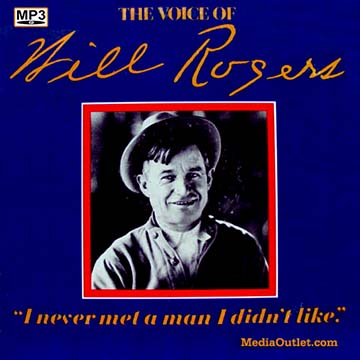
November 4, 1879: #BOTD: #HBD! Will
Rogers, American cowboy, vaudeville performer, stage and motion
picture actor, newspaper columnist, and social commentator
humorist (d. August 15, 1935) is #born William Penn Adair Rogers
as a citizen of the Cherokee Nation in Oologah, Indian Territory
(now Oklahoma), and is known as "Oklahoma's Favorite Son".
As an entertainer and humorist, he traveled around the world three
times, made 71 films (50 silent films and 21 "talkies"),
and wrote more than 4,000 nationally syndicated newspaper columns.
By the mid-1930s, Rogers was hugely popular in the United States
for his leading political wit and was the highest paid of
Hollywood film stars. He died in 1935 with aviator Wiley Post when
their small airplane crashed in northern Alaska. Rogers began his
career as a performer on vaudeville. His rope act led to success
in the Ziegfeld Follies, which in turn led to the first of his
many movie contracts. His 1920s syndicated newspaper column and
his radio appearances increased his visibility and popularity.
Rogers crusaded for aviation expansion and provided Americans with
first-hand accounts of his world travels. His earthy anecdotes and
folksy style allowed him to poke fun at gangsters, prohibition,
politicians, government programs, and a host of other
controversial topics in a way that found general acclaim from a
national audience with no one offended. His aphorisms, couched in
humorous terms, were widely quoted: "I am not a member of an
organized political party. I am a Democrat." One of Rogers's
most famous sayings was "I never met a man I didn't like"
and he even provided an epigram on this famous epigram: "When
I die, my epitaph, or whatever you call those signs on
gravestones, is going to read: "I joked about every prominent
man of my time, but I never met a man I dident [sic] like." I
am so proud of that, I can hardly wait to die so it can be
carved." "All I know is what I read in the newspapers,"
he once joked. He was killed in an airplane crash along with the
airplane's pilot, aviation pioneer Wiley Post, after their
aircraft developed engine problems during takeoff in Barrow,
Alaska. He is buried at The Will Rogers Museum Grounds in
Claremore, Oklahoma. On Sale @ 15% Off Discount Till Midnight PT!
https://store.earthstation1.com/the-voice-of-will-rogers-comedy-album-lp-mp3-c3.html
Today's
EarthStation1.com 15% Off Commemorative Memorial Title: The Birth
Of Europe: Ice Age To 20th Century DVD, Video Download, USB
Today, November 4, 2025
November 4, 1890: The History Of Rail
Transport (The History Of Railways): Rapid Transit (Mass Rapid
Transit [MRT], Heavy Rail, Metro): History Of The Subway (Tube,
Underground): The City And South London Railway: --- The world's
first deep-level underground "tube" railway, and the
world's first major railway to use electric traction, is
officially opened in London. The City and South London Railway (C
& S L R) was originally intended for cable-hauled trains, but
owing to the bankruptcy of the cable contractor during
construction, a system of electric traction using electric
locomotives, an experimental technology at the time, was chosen
instead. When opened in 1890, the line had six stations and ran
for 3.2 miles (5.1 km) in a pair of tunnels between the City of
London and Stockwell, passing under the River Thames. The diameter
of the tunnels restricted the size of the trains, and the small
carriages with their high-backed seating were nicknamed padded
cells. The railway was extended several times north and south,
eventually serving 22 stations over a distance of 13.5 miles (21.7
km) from Camden Town in north London to Morden in south London.
Although the C & S L R was well used, low ticket prices and
the construction cost of the extensions placed a strain on the
company's finances. In 1913, the C & S L R became part of the
Underground Group of railways and, in the 1920s, it underwent
major reconstruction works before its merger with another of the
Group's railways, the Charing Cross, Euston & Hampstead
Railway, forming a single London Underground line called the
Morden-Edgware line. In 1933, the C & S L R and the rest of
the Underground Group was taken into public ownership. Today, its
tunnels and stations form the Bank Branch of the Northern line
from Camden Town to Kennington and the southern leg of the line
from Kennington to Morden. On Sale @ 15% Off Discount Till
Midnight PT!
https://store.earthstation1.com/the-birth-of-europe-european-history-from-the-ice-age-to-20th-centu20.html
Today's
EarthStation1.com 15% Off Commemorative Memorial Title: Medal Of
Honor: World War II: Pearl Harbor & Pacific MP4 Download DVD
Today, November 4, 2025
November 4, 1916: #BOTD: #HBD! John
Basilone, United States Marine Corps Gunnery Sergeant who received
the Medal Of Honor for heroism above and beyond the call of duty
during the Battle For Henderson Field in the Guadalcanal campaign,
and the Navy Cross posthumously for extraordinary heroism during
the Battle Of Iwo Jima, the only enlisted Marine to receive both
of these decorations in World War II (d. February 19, 1945) is
#born in his Italian American parents' home on November 4, 1916,
in Buffalo, New York. He enlisted in the Marine Corps on June 3,
1940, after serving three years in the United States Army with
duty in the Philippines. He was deployed to Guantanamo Bay, Cuba,
and in August 1942, he took part in the invasion of Guadalcanal.
In October, he and the two machine-gun sections under his command
held off an attack by a numerically far superior Japanese force.
He was one of only three Marines in that group to survive. His
actions at Guadalcanal earned him the Medal Of Honor. In February
1945, he was killed in action on the first day of the invasion of
Iwo Jima, after he single-handedly destroyed an enemy blockhouse
and led a Marine tank under fire safely through a minefield. He is
buried at Arlington National Cemetery. Including the Medal Of
Honor, he has received many honors, including having base streets,
military facilities, and two United States Navy destroyers named
for him. On Sale @ 15% Off Discount Till Midnight PT!
https://store.earthstation1.com/medal-of-honor-world-war-ii-pearl-harbor-amp-pacific-mp4-download-dv4.html
Today's
EarthStation1.com 15% Off Commemorative Memorial Title: The
Presidential Inauguration With Walter Cronkite DVD, Download, USB
Today, November 4, 2025
November 4, 1916: #BOTD: #HBD! Walter
Cronkite, American print and broadcast journalist, news anchor,
documentary host and actor from a Freemasonic family (d. July 17,
2009) is #born Walter Leland Cronkite Jr. in St. Joseph, Missouri.
Cronkite served as anchorman for the CBS Evening News for 19 years
(1962-1981). During the heyday of CBS News in the 1960s and 1970s,
he was often cited as "the most trusted man in America"
after being so named in an opinion poll. He was a leading
correspondent for United Press International during World War II.
He reported many events from 1937 to 1981, including bombings in
World War II; the Nuremberg trials; combat in the Vietnam War; the
Dawson's Field hijackings; Watergate; the Iran Hostage Crisis; and
the assassinations of President John F. Kennedy, civil rights
pioneer Martin Luther King Jr., and Beatles musician John Lennon.
He was also known for his extensive coverage of the U.S. space
program, from Project Mercury to the Moon landings to the Space
Shuttle. He was the only non-NASA recipient of an Ambassador of
Exploration award. Cronkite is well known for his departing
catchphrase "And that's the way it is," followed by the
broadcast's date. Walter Cronkite died at his home in New York
City aged 92, his death believed to caused by cerebrovascular
disease. Cronkite's funeral took place on July 23, 2009, at St.
Bartholomew's Church in midtown Manhattan, New York City. Among
many journalists who attended were Tom Brokaw, Connie Chung, Katie
Couric, Charles Gibson, Matt Lauer, Dan Rather, Andy Rooney,
Morley Safer, Diane Sawyer, Bob Schieffer, Meredith Vieira,
Barbara Walters, and Brian Williams. At his funeral, his friends
noted his love of music, including, recently, drumming. He remains
were cremated and his ashes buried next to his wife, Betsy, in the
family plot in Kansas City. On Sale @ 15% Off Discount Till
Midnight PT!
https://store.earthstation1.com/the-presidential-inauguration-with-walter-cronkite-dvd.html
Today's
EarthStation1.com 15% Off Commemorative Memorial Title: Art
Carney: His Golden Age Of TV Shows DVD, Video Download, USB Drive
Today, November 4, 2025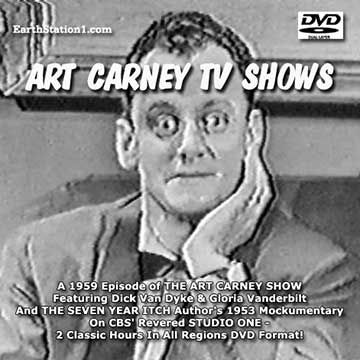
November 4, 1918: #BOTD: #HBD! Art
Carney, American actor in film, stage, television and radio (d.
November 9, 2003) is #born Arthur William Matthew Carney in Mount
Vernon, New York into an Irish American Catholic family. Art
Carney is best known for playing sewer worker Ed Norton opposite
Jackie Gleason's Ralph Kramden in the sitcom The Honeymooners, and
for winning the Academy Award for Best Actor for his role in Harry
and Tonto. A gifted mimic, worked steadily in radio during the
1940s, playing character roles and impersonating celebrities such
as President Franklin D. Roosevelt and Winston Churchill; he was
originally hired by CBS because of his FDR impression. Roosevelt
himself was so impressed that he had Carney impersonate him in at
least one of FDR's famous "fireside chats" to hide the
fact that the President had went abroad to attend conferences with
the Allied powers during World War II. Art Carney died in his
sleep of natural causes at his home in Chester, Connecticut, five
days after his 85th birthday. He is interred at Riverside Cemetery
in Old Saybrook, Connecticut. On Sale @ 15% Off Discount Till
Midnight PT!
https://store.earthstation1.com/art-carney-dvd-tv-shows-old-time-television.html
Today's
EarthStation1.com 15% Off Commemorative Memorial Title: Howard
Carter: The Quest For King Tutankhamun's Tomb MP4 Download DVD
Today, November 4, 2025
November 4, 1922: Archaeology
(Archeology): Great Discoveries Of Archaeology: Egypt: Ancient
Egypt: New Kingdom: Eighteenth Dynasty (The Eighteenth Dynasty Of
Egypt, Dynasty XVIIII, 18th Dynasty, Dynasty 18): Tutankhamun: The
Tomb Of Tutankhamun (Valley Of The Kings Tomb KV62): The Discovery
Of The Tomb Of Tutankhamun -- English archaeologist Howard Carter
discovers, after seven difficult years of searching, the first
concealed step of what he knew was going to turn out to be the
lost tomb of Egyptian pharaoh Tutankhamun (King Tut) in the Valley
of the Kings at Luxor, Egypt. By February 1923 the antechamber had
been cleared of everything but two sentinel statues. A day and
time were selected to unseal the tomb with about twenty appointed
witnesses that included Carter's financial backer Lord Carnarvon,
several Egyptian officials, museum representatives and the staff
of the Government Press Bureau. On February 17, 1923 at just after
two o'clock, the seal was broken. The child-king Tutankhamen
became pharaoh at age nine and died around 1352 B.C. at age 19.
The tomb was found mostly intact, containing numerous priceless
items now exhibited in Egypt's National Museum in Cairo. There
were 5,398 items found in the tomb, including a solid gold coffin,
face mask, thrones, archery bows, trumpets, a lotus chalice, two
Imiut fetishes, gold toe stalls, furniture, food, wine, sandals,
and fresh linen underwear. Howard Carter took 10 years to catalog
the items. Recent analysis suggests a dagger recovered from the
tomb had an iron blade made from a meteorite; study of artifacts
of the time including other artifacts from Tutankhamun's tomb
could provide valuable insights into metalworking technologies
around the Mediterranean at the time. Tutankhamun (c. 1342 - c.
1325 BC), was an ancient Egyptian pharaoh who was the last of his
royal family to rule during the end of the 18th Dynasty (ruled c.
1334 - 1325 BC in the conventional chronology) during the New
Kingdom of Egyptian history. His father was the pharaoh Akhenaten,
believed to be the mummy found in the tomb KV55. His mother is his
father's sister, identified through DNA testing as an unknown
mummy referred to as "The Younger Lady" who was found in
KV35. Tutankhamun took the throne at eight or nine years of age
under the unprecedented viziership of his eventual successor, Ay,
to whom he may have been related. He married his half sister
Ankhesenamun. During their marriage they lost two daughters, one
at 5-6 months of pregnancy and the other shortly after birth at
full-term. His names-Tutankhaten and Tutankhamun-are thought to
mean "Living image of Aten" and "Living image of
Amun", with Aten replaced by Amun after Akhenaten's death. A
small number of Egyptologists, including Battiscombe Gunn, believe
the translation may be incorrect and closer to
"The-life-of-Aten-is-pleasing" or, as Professor Gerhard
Fecht believes, reads as "One-perfect-of-life-is-Aten".
Tutankhamun restored the Ancient Egyptian religion after its
dissolution by his father, enriched and endowed the priestly
orders of two important cults and began restoring old monuments
damaged during the previous Amarna period. He moved his father's
remains to the Valley of the Kings as well as moving the capital
from Akhetaten to Thebes. Tutankhamun was physically disabled with
a deformity of his left foot along with bone necrosis that
required the use of a cane, several of which were found in his
tomb. He had other health issues including scoliosis and had
contracted several strains of malaria. The 1922 discovery by
Howard Carter of Tutankhamun's nearly intact tomb, in excavations
funded by Lord Carnarvon, received worldwide press coverage. With
over 5,000 artifacts, it sparked a renewed public interest in
ancient Egypt, for which Tutankhamun's mask, now in the Egyptian
Museum, remains a popular symbol. The deaths of a few involved in
the discovery of Tutankhamun's mummy have been popularly
attributed to the curse of the pharaohs. He has, since the
discovery of his intact tomb, been referred to colloquially as
"King Tut". Some of his treasure has traveled worldwide
with unprecedented response. The Egyptian Supreme Council of
Antiquities allowed tours beginning in 1962 with the exhibit at
the Louvre in Paris, followed by the Kyoto Municipal Museum of Art
in Tokyo, Japan. The exhibits drew in millions of visitors. The
1972-1979 exhibit was shown in United States, Soviet Union, Japan,
France, Canada, and West Germany. There were no international
exhibitions again until 2005-2011. This exhibit featured
Tutankhamun's predecessors from the 18th Dynasty, including
Hatshepsut and Akhenaten, but did not include the golden death
mask. The treasures 2019-2022 tour began in Los Angeles and will
end in 2022 at the new Grand Egyptian Museum in Cairo, which, for
the first time, will be displaying the full Tutankhamun
collection, gathered from all of Egypt's museums and storerooms.
On Sale @ 15% Off Discount Till Midnight PT!
https://store.earthstation1.com/howard-carter-the-quest-for-king-tutankhamuns-tomb-mp4-download-dvd.html
Today's
EarthStation1.com 15% Off Commemorative Memorial Title: The Road
To War: Years Between WWI & WWII TV Series DVD, Download, USB
Today, November 4, 2025
November 4, 1939: The Interwar Period
(The Aftermath Of World War I, The Interbellum, Between The Wars):
Isolationism (Non-Interventionism): United States Isolationism
(United States Non-Interventionism): The Road To War: Neutrality
Acts Of The 1930s (The Neautrality Acts): The Neutrality Act Of
1939: -- U.S. President Franklin D. Roosevelt signs the Neutrality
Act Of 1939 into law, requiring the United States Customs Service
to allowing cash-and-carry purchases of weapons by belligerents.
Early in 1939, after Nazi Germany had invaded Czechoslovakia,
Roosevelt lobbied Congress to have the cash-and-carry provision
renewed. He was rebuffed, the provision lapsed, and the mandatory
arms embargo remained in place. In September 1939, after Germany
had invaded Poland, the United Kingdom and France declared war on
Germany. Roosevelt invoked the provisions of the Neutrality Act
but came before Congress and lamented that the Neutrality Acts may
give passive aid to an aggressor country. Congress was divided.
Republican Senator Gerald Nye wanted to broaden the embargo, and
other isolationists like Vandenberg and Hiram Johnson vowed to
fight "from hell to breakfast" Roosevelt's desire to
loosen the embargo. An "outstanding Republican leader"
who supported helping nations under attack, however, told H. V.
Kaltenborn that the embargo was futile because a neutral country
like Italy could buy from the US and sell its own weapons to
Germany, while US companies would relocate factories to Canada.
Roosevelt prevailed over the isolationists, and on November 4, he
signed the Neutrality Act Of 1939 into law, allowing for arms
trade with belligerent nations (Great Britain and France) on a
cash-and-carry basis, thus in effect ending the arms embargo.
Furthermore, the Neutrality Acts of 1935 and 1937 were repealed,
American citizens and ships were barred from entering war zones
designated by the president, and the National Munitions Control
Board (which had been created by the 1935 Neutrality Act) was
charged with issuing licenses for all arms imports and exports.
Arms trade without a license became a federal crime. The
Neutrality Acts were a series of acts passed by the US Congress in
1935, 1936, 1937, and 1939 in response to the growing threats and
wars that led to World War II. They were spurred by the growth in
isolationism and non-interventionism in the US following the US
joining World War I, and they sought to ensure that the US would
not become entangled again in foreign conflicts. The legacy of the
Neutrality Acts is widely regarded as having been generally
negative since they made no distinction between aggressor and
victim, treating both equally as belligerents, and limited the US
government's ability to aid Britain and France against Nazi
Germany. The Acts were largely repealed in 1941, in the face of
the Lend-Lease Act. On Sale @ 15% Off Discount Till Midnight PT!
https://store.earthstation1.com/the-road-to-war-dvd-set-all-8-tv-shows-4-dis84.html
Today's
EarthStation1.com 15% Off Commemorative Memorial Title: Turning
Points Of Second World War Midway El Alamein Stalingrad DVD MP4
USB
Today, November 4, 2025
November 4, 1942: The European Civil War:
World War II: The Second European War (The European Theater Of
World War II): The North African Campaign: The Western Desert
Campaign (The Desert War): The Battles Of El Alamein: The Second
Battle Of El Alamein: -- British Eighth Army troops led by Field
Marshal Bernard Montgomery defeat the German Afrika Korps troops
under General Field Marshal Erwin Rommel at El Alamein, a town in
the northern Matrouh Governorate in northern Egypt, after a
twelve-day battle, a critical offensive to expel the Axis armies
from Egypt. The Second Battle Of El Alamein (October 23 - November
11, 1942) took place near the Egyptian railway halt of El Alamein.
The First Battle Of El Alamein and the Battle Of Alam El Halfa had
prevented the Axis from advancing further into Egypt. In August
1942, General Claude Auchinleck had been relieved as
Commander-In-Chief Middle East Command, and his successor,
Lieutenant-General William Gott was killed on his way to replace
him as commander of the Eighth Army. Lieutenant-General Bernard
Montgomery was hastily appointed in the aftermath of Gott's death,
and he led the Eighth Army offensive. The ultimate Allied victory
was the beginning of the end of the Western Desert Campaign,
eliminating the Axis threat to Egypt, the Suez Canal and the
Middle Eastern and Persian oil fields. The battle revived the
morale of the Allies, being the first big success against the Axis
since Operation Crusader in late 1941. The battle coincided with
the Allied invasion of French North Africa in Operation Torch on
November 8, the Battle Of Stalingrad and the Guadalcanal Campaign.
On Sale @ 15% Off Discount Till Midnight PT!
https://store.earthstation1.com/turning-points-of-2nd-world-war-midway-el-alamein-stalingrad-dv2.html
Today's
EarthStation1.com 15% Off Commemorative Memorial Title: The
Machine That Changed The World The Computer + Bonus 3 MP4s Or DVDs
Today, November 4, 2025
November 4, 1952: The Elections:
Elections In The United States: 1952 United States Presidential
Election: -- Republican Dwight D. Eisenhower wins a landslide
victory over Democrat Adlai Stevenson II, which ends a string of
Democratic Party Presidential election wins that stretched back to
1932. The election was the first in which a computer, the UNIVAC
I, was used to predict the results live on CBS television; UNIVAC
accurately predicted Eisenhower's victory early in the evening,
and its tally came within 3.5% of Eisenhower's popular vote tally
and four votes of his electoral vote total, but despite this
accuracy, and due to the novelty of the system, CBS executives
refused to report these results, despite prominently featuring
UNIVAC during their live election reporting, because they believed
that this as yet unproven voting technology was wrong. The 1952
United States presidential election was the 42nd quadrennial
presidential election. Illinois Governor Stevenson, emerged
victorious on the third presidential ballot of the 1952 Democratic
National Convention by defeating Tennessee Senator Estes Kefauver,
Georgia Senator Richard Russell Jr., and other candidates. The
Republican nomination was primarily contested by Eisenhower, a
general who was widely popular for his leadership in World War II,
and the conservative Ohio Senator Robert A. Taft. With the support
of Thomas E. Dewey and other party leaders, Eisenhower narrowly
prevailed over Taft at the 1952 Republican National Convention
with Richard Nixon, a young senator from California, as his
running mate. In the first televised presidential campaign,
Eisenhower, in sharp contrast to Stevenson, was charismatic and
very well known. Republicans attacked Truman's handling of the
Korean War and the broader Cold War and alleged that Soviet spies
had infiltrated the US government. Democrats faulted Eisenhower
for failing to condemn Senators Joseph McCarthy, William E.
Jenner, and other reactionary Republicans, who, they alleged, had
engaged in reckless and unwarranted attacks. Stevenson tried to
separate himself from the unpopular Truman administration but
instead campaigned on the popularity of the New Deal and stoked
fears of another Great Depression under a Republican
administration. Eisenhower retained his enormous popularity from
the war, as was seen in his campaign slogan, "I Like Ike."
Eisenhower's popularity and Truman's unpopularity led to a
Republican victory, with Eisenhower winning 55.18% of the popular
vote and carrying every state outside of the South and even
Virginia, Tennessee, Florida, and Texas, Southern states that had
voted for Democrats since the end of Reconstruction, with the
exception of 1928. Republicans made gains among Democrats,
especially urban and suburban Southerners, and white ethnics in
the Northeast and Midwest. This was the first time a Republican
won without West Virginia since 1888, and the first time a
Republican won the popular vote without carrying West Virginia
since 1880. This was the first time and only time since 1920 that
a Republican won without Kentucky. Republicans also won control of
both houses of Congress, marking the first time since 1840 that
one party flipped the Presidency and both houses of Congress in a
single election. On Sale @ 15% Off Discount Till Midnight PT!
https://store.earthstation1.com/the-machine-that-changed-the-world-the-computer-dvd-mp4-downloa4.html
Today's
EarthStation1.com 15% Off Commemorative Memorial Title: Secret
Intelligence: US Espionage History TV Series DVD MP4 USB
Today, November 4, 2025
November 4, 1952: The Aftermath Of World
War II: The Cold War: Global Surveillance: The United States
Department Of Defense (DoD, USDOD, DOD): Intelligence Agencies:
The National Security Agency (NSA): -- On the same day that Dwight
D. Eisenhower was first elected President Of The United States,
Secretary Of Defense Robert A. Lovett, pursuant to two memoranda
of October 24, 1952 -- (1: a National Security Council memorandum
that revised National Security Council Intelligence Directive
(NSCID) 9, and 2: Truman second memorandum that called for the
establishment of a National Security Agency) -- himself issues a
memorandum on November 4, 1952 that changes the name of the Armed
Forces Security Agency (AFSA) (AFSA) to the National Security
Agency (NSA) and makes the new agency responsible for all
communications intelligence. National security directives are
generally highly classified and are available to the public only
after, in the words of the United States Government Accounting
Office, "a great many years" have elapsed, the existence
of the NSA was not known to the public at that time. Due to its
ultra-secrecy the U.S. intelligence community referred to the NSA
as "No Such Agency". During World War II, the Signal
Intelligence Service (SIS) was created to intercept and decipher
the communications of the Axis powers. When the war ended, the SIS
was reorganized as the Army Security Agency (ASA), and it was
placed under the leadership of the Director of Military
Intelligence. On May 20, 1949, all cryptologic activities were
centralized under a national organization called the Armed Forces
Security Agency (AFSA). This organization was originally
established within the U.S. Department of Defense under the
command of the Joint Chiefs Of Staff. The AFSA was tasked to
direct Department of Defense communications and electronic
intelligence activities, except those of U.S. military
intelligence units. However, the AFSA was unable to centralize
communications intelligence and failed to coordinate with civilian
agencies that shared its interests such as the Department of
State, Central Intelligence Agency (CIA) and the Federal Bureau of
Investigation (FBI). In December 1951, President Harry S. Truman
ordered a panel to investigate how AFSA had failed to achieve its
goals. The results of the investigation led to improvements and
its redesignation as the National Security Agency (NSA), a
national-level intelligence agency of the United States Department
of Defense, under the authority of the Director of National
Intelligence (DNI). The NSA is responsible for global monitoring,
collection, and processing of information and data for foreign and
domestic intelligence and counterintelligence purposes,
specializing in a discipline known as signals intelligence
(SIGINT). The NSA is also tasked with the protection of U.S.
communications networks and information systems. The NSA relies on
a variety of measures to accomplish its mission, the majority of
which are clandestine. The existence of the NSA was not revealed
until 1975. The NSA has roughly 32,000 employees. Originating as a
unit to decipher coded communications in World War II, it was
officially formed as the NSA by President Harry S. Truman in 1952.
Between then and the end of the Cold War, it became the largest of
the U.S. intelligence organizations in terms of personnel and
budget, but information available as of 2013 indicates that the
Central Intelligence Agency (CIA) pulled ahead in this regard,
with a budget of $14.7 billion. The NSA currently conducts
worldwide mass data collection and has been known to physically
bug electronic systems as one method to this end. The NSA is also
alleged to have been behind such attack software as Stuxnet, which
severely damaged Iran's nuclear program. The NSA, alongside the
CIA, maintains a physical presence in many countries across the
globe; the CIA/NSA joint Special Collection Service (a highly
classified intelligence team) inserts eavesdropping devices in
high value targets (such as presidential palaces or embassies).
SCS collection tactics allegedly encompass "close
surveillance, burglary, wiretapping, [and] breaking and entering".
Unlike the CIA and the Defense Intelligence Agency (DIA), both of
which specialize primarily in foreign human espionage, the NSA
does not publicly conduct human-source intelligence gathering. The
NSA is entrusted with providing assistance to, and the
coordination of, SIGINT elements for other government
organizations - which are prevented by law from engaging in such
activities on their own. As part of these responsibilities, the
agency has a co-located organization called the Central Security
Service (CSS), which facilitates cooperation between the NSA and
other U.S. defense cryptanalysis components. To further ensure
streamlined communication between the signals intelligence
community divisions, the NSA Director simultaneously serves as the
Commander of the United States Cyber Command and as Chief of the
Central Security Service. The NSA's actions have been a matter of
political controversy on several occasions, including its spying
on anti-Vietnam War leaders and the agency's participation in
economic espionage. In 2013, the NSA had many of its secret
surveillance programs revealed to the public by Edward Snowden, a
former NSA contractor. According to the leaked documents, the NSA
intercepts and stores the communications of over a billion people
worldwide, including United States citizens. The documents also
revealed the NSA tracks hundreds of millions of people's movements
using cellphones' metadata. Internationally, research has pointed
to the NSA's ability to surveil the domestic Internet traffic of
foreign countries through "boomerang routing". On Sale @
15% Off Discount Till Midnight PT!
https://store.earthstation1.com/secret-intelligence-us-espionage-history-tv-series-dvd-mp4-us4.html
Today's
EarthStation1.com 15% Off Commemorative Memorial Title: Communism
With Tanks: Hungarian & East Bloc Revolutions DVD, MP4, USB
Today, November 4, 2025
November 4, 1956: The Aftermath Of World
War II: The Cold War: The Eastern Bloc (The Communist Bloc, The
Socialist Bloc, The Soviet Bloc): Cold War Rebellions:
Anti-Communist Insurgencies In Central And Eastern Europe: The
Hungarian Revolution Of 1956 (The Hungarian Uprising): -- Soviet
troops enter Hungary to crush the Hungarian revolution against the
Soviet Union; Hungarian revolutionaries resist them until November
10, by which time 2,500 Hungarians and 700 Soviet Army soldiers
are killed, and 200,000 Hungarians flee the country to seek
political refuge abroad. The Hungarian Revolution began on October
23, 1956 in Budapest when university students appealed to the
civil populace to join them at the Hungarian Parliament Building
to protest against the USSR's geopolitical domination of Hungary
with the Stalinist government of Matyas Rakosi. A delegation of
students entered the building of Hungarian Radio to broadcast
their sixteen demands for political and economic reforms to the
civil society of Hungary, but they were instead detained by
security guards. When the student protestors outside the radio
building demanded the release of their delegation of students,
policemen from the AVH (Allamvedelmi Hatosag) state protection
authority shot and killed several protestors. Consequently,
Hungarians organized into revolutionary militias to fight against
the AVH; local Hungarian communist leaders and AVH policemen were
captured and summarily killed or lynched; and anti-communist
political prisoners were released and armed. To realize their
political, economic, and social demands, the local soviets
(councils of workers) assumed control of municipal government from
the Hungarian Working People's Party (Magyar Dolgozok Partja). The
new government of Imre Nagy disbanded the AVH, declared the
Hungarian withdrawal from the Warsaw Pact, and pledged to
re-establish free elections. By the end of October the intense
fighting had subsided. Although initially willing to negotiate the
withdrawal of the Soviet Army from Hungary, the USSR repressed the
Hungarian Revolution on 4 November 1956, and fought the Hungarian
revolutionaries until November 10. On Sale @ 15% Off Discount Till
Midnight PT!
https://store.earthstation1.com/communism-with-tanks-dvd-hungarian-east-bloc-revolutions.html
Today's
EarthStation1.com 15% Off Commemorative Memorial Title: CIA The
Secret Files The Central Intelligence Agency TV Series MP4 DVD
Today, November 4, 2025
November 4, 1970: The Aftermath Of World
War II: The Cold War: The Cold War In South America: Chile: The
History Of Chile: The 1970 Chilean Presidential Election: The
Election Of Salvador Allende As President Of Chile: -- Salvador
Allende takes office as President of Chile, the first Marxist to
become president of a Latin American country through open
elections. Presidential elections were held in Chile on September
4 1970. Salvador Allende of the Popular Unity alliance won a
narrow plurality in a race against independent Jorge Alessandri
and Christian Democrat Radomiro Tomic, before having his victory
confirmed by a Congressional vote after the Christian Democrats
voted in favour of his candidacy. Both the United States and the
Soviet Union poured money into this election through their
intelligence agencies and other sources, with the former
attempting to sabotage Allende, and the latter supporting his
campaign. Ambassador Edward Korry would play a major role in
anti-Allende campaigns during the election. Eduardo Frei Montalva
and his Christian Democratic Party would later unite with
Allende's opponents to form a congressional majority in an attempt
to declare his presidency illegal in August 1973, catalyzing the
military's September 11, 1973 Chilean Coup D'Etat. On Sale @ 15%
Off Discount Till Midnight PT!
https://store.earthstation1.com/cia-the-secret-files-the-central-intelligence-agency-tv-series-mp4-dv4.html
Today's
EarthStation1.com 15% Off Commemorative Memorial Title: America
Held Hostage: As It Happened The Iran Hostage Crisis MP4 DVD
Today, November 4, 2025
November 4, 1979: The Aftermath Of World
War II: The Cold War: The Cold War (1962-1979): The Iranian
Revolution: The Cold War (1979-1985): Aftermath Of The Iranian
Revolution: The Iran Hostage Crisis: -- The Iran Hostage Crisis
begins when a group of Iranian college students overruns the U.S.
embassy in Tehran and takes 90 hostages. The Iran Hostage Crisis
was a diplomatic standoff between the United States and Iran.
Fifty-two American diplomats and citizens were held hostage for
444 days from November 4, 1979, to January 20, 1981, after a group
of Iranian college students belonging to the Muslim Student
Followers of the Imam's Line, who supported the Iranian
Revolution, took over the U.S. Embassy in Tehran. Western media
described the crisis as an "entanglement" of "vengeance
and mutual incomprehension." American President Jimmy Carter
called the hostage-taking an act of "blackmail" and the
hostages "victims of terrorism and anarchy." In Iran it
was widely seen as an act against the U.S. and its influence in
Iran, including its perceived attempts to undermine the Iranian
Revolution and its longstanding support of the Shah of Iran,
Mohammad Reza Pahlavi, who was overthrown in 1979. After Shah
Pahlavi was overthrown, he was admitted to the U.S. for cancer
treatment. Iran demanded his return in order to stand trial for
crimes that he was accused of committing during his reign.
Specifically, he was accused of committing crimes against Iranian
citizens with the help of his secret police. Iran's demands were
rejected by the United States, and Iran saw the decision to grant
him asylum as American complicity in those atrocities. The
Americans saw the hostage-taking as an egregious violation of the
principles of international law, such as the Vienna Convention,
which granted diplomats immunity from arrest and made diplomatic
compounds inviolable. The Shah left the United States in December
1979 and was ultimately granted asylum in Egypt, where he died
from complications of cancer at age 60 on July 27, 1980. Six
American diplomats who had evaded capture had been rescued by a
joint CIA-Canadian effort on January 27, 1980. The crisis reached
a climax after diplomatic negotiations failed to win the release
of the hostages. Carter ordered the U.S. military to attempt a
rescue mission - Operation Eagle Claw - using warships that
included the USS Nimitz and USS Coral Sea, which were patrolling
the waters near Iran. The failed attempt on April 24, 1980
resulted in the death of one Iranian civilian, and the accidental
deaths of eight American servicemen after one of the helicopters
crashed into a transport aircraft. United States Secretary Of
State Cyrus Vance resigned his position following the failure. In
September 1980 Iraq invaded Iran, beginning the Iran-Iraq War.
These events led the Iranian government to enter negotiations with
the U.S., with Algeria acting as a mediator. The crisis is
considered a pivotal episode in the history of Iran-United States
relations. Political analysts cited the standoff as a major factor
in the continuing downfall of Carter's presidency and his
landslide loss in the 1980 presidential election; the hostages
were formally released into United States custody the day after
the signing of the Algiers Accords, just minutes after American
President Ronald Reagan was sworn into office. In Iran the crisis
strengthened the prestige of Ayatollah Ruhollah Khomeini and the
political power of theocrats who opposed any normalization of
relations with the West. The crisis also led to American economic
sanctions against Iran, which further weakened ties between the
two countries. On Sale @ 15% Off Discount Till Midnight PT!
https://store.earthstation1.com/america-held-hostage-as-it-happened-the-iran-hostage-crisis-mp4-dv4.html
Today's
EarthStation1.com #OnThisDay Commemorative Memorial Title: Fibber
McGee And Molly Complete Radio Series MP3 DVD, Download, USB
Today, November 4, 2025 November 4: Roast Dinner Day (United
Kingdom): -- An annual observance on behalf of National School
Meals Week, the national charity "Food for Life" and its
communities come together to enjoy a roast meal. Roast Dinner Day
honors the importance of bringing people together over lunch to
encourage students to eat school meals. It's also a great way to
encourage youngsters to consume nutritious, hot lunches. The day
can hold in various settings, including middle schools, nursing
homes, community groups, and even your own house. The Sunday Roast
is a dinner that originated in the British Isles, namely in
Yorkshire. Roast is a supper consumed after church service on
Sunday. Although most of Europe follows the practice of eating
enormous dinners after church services, the Sunday Roast version
that evolved in the British Isles is distinctive. All varieties of
meat and dairy products are allowed in a conventional roast.
Almost every home throughout the Industrial Age would prepare a
roast before attending church on Sunday. It had taken on a
religious and social significance of its own. The Sunday roast may
be traced back to its humble roots of 100 years ago when it
consisted of boiled beef, broad beans, and cabbage. In 1485,
during King Henry VII's reign, the Sunday roast was very popular.
The British used to eat a lot more meat back in the day. Because
of the Yeomen of the Guard's fondness for roast beef, the royal
bodyguards have been lovingly nicknamed 'Beefeaters' since the
15th century. In the 19th century, a 6.6-pound beef intake was
recommended weekly for an English person. Since the 1920s,
Yorkshire puddings, meat, and roast potatoes have been a staple of
the English classic. Recently, vegetarian and vegan choices have
been increasingly popular on dinner tables.
https://store.earthstation1.com/fibber-mcgee-and-molly-mp3-dvd-complete-radio-serie3.html
November 4: Roast Dinner Day (United
Kingdom): -- An annual observance on behalf of National School
Meals Week, the national charity "Food for Life" and its
communities come together to enjoy a roast meal. Roast Dinner Day
honors the importance of bringing people together over lunch to
encourage students to eat school meals. It's also a great way to
encourage youngsters to consume nutritious, hot lunches. The day
can hold in various settings, including middle schools, nursing
homes, community groups, and even your own house. The Sunday Roast
is a dinner that originated in the British Isles, namely in
Yorkshire. Roast is a supper consumed after church service on
Sunday. Although most of Europe follows the practice of eating
enormous dinners after church services, the Sunday Roast version
that evolved in the British Isles is distinctive. All varieties of
meat and dairy products are allowed in a conventional roast.
Almost every home throughout the Industrial Age would prepare a
roast before attending church on Sunday. It had taken on a
religious and social significance of its own. The Sunday roast may
be traced back to its humble roots of 100 years ago when it
consisted of boiled beef, broad beans, and cabbage. In 1485,
during King Henry VII's reign, the Sunday roast was very popular.
The British used to eat a lot more meat back in the day. Because
of the Yeomen of the Guard's fondness for roast beef, the royal
bodyguards have been lovingly nicknamed 'Beefeaters' since the
15th century. In the 19th century, a 6.6-pound beef intake was
recommended weekly for an English person. Since the 1920s,
Yorkshire puddings, meat, and roast potatoes have been a staple of
the English classic. Recently, vegetarian and vegan choices have
been increasingly popular on dinner tables.
https://store.earthstation1.com/fibber-mcgee-and-molly-mp3-dvd-complete-radio-serie3.html
Today's
EarthStation1.com #OnThisDay Commemorative Memorial Title: Lenny
Bruce Comedy Album MP3 MegaSet CD, MP3 Download, USB Flash Drive
Today, November 4, 2025November 4: National Candy Day: -- A
sweet annual holiday! Candies have a long history of attracting us
with their bright colors and delightful flavors. They also come in
a variety of fun sizes and shapes. In the late 13th century,
Middle English first began using the word candy. Borrowed from the
Old French cucre candi, it is derived in turn from Persian Qand
and Qandi, cane sugar. People use the term candy as a broad
category. We treat candy bars, chocolates, licorice, sour candies,
salty candies, tart candies, hard candies, taffies, gumdrops,
marshmallows and much more as candy. However, sugar was not always
readily available. So instead, people made the first candies from
honey. Candymakers coated nuts, fruits and flowers with honey.
This method preserved the flowers and nuts or created forms of
candy. Today, we still create these confections, but we typically
use them as a garnish. Originally a form of medicine, candy calmed
the digestive system or cooled a sore throat. At that time,
combined with spices and sugar, candy only appeared in the purses
and the dishes of the wealthy. By the 18th century, the first
candy likely came to America from Britain and France. At the time,
people made the simplest form of candy from crystallized sugar -
rock candy. However, even the most basic form of sugar was
considered a luxury and only attainable by the wealthy. Since
1979, the world has produced more sugar than can be sold, making
it very attainable and cheap. With the advent of the industrial
revolution, many advances improved the availability of sugar. By
the 1830s, markets opened, and the candy business underwent a
drastic change. Not only did the price of candy drop, but penny
candies targeted children. To observe National Candy Day, - which
is just four days after Halloween - you should have no problem
celebrating this day! Either celebrate with your leftover candy,
or can ask your kid to share some of their Halloween stash to
celebrate. You can also scan the sales of Halloween candy at your
local stores. Or, invite some friends to enjoy their favorite
candies with you! While you're celebrating, be sure to use
#NationalCandyDay to post on social media!
https://store.earthstation1.com/lenny-bruce-comedy-album-mp3-megase3.html
Today's
EarthStation1.com #OnThisDay Commemorative Memorial Title: Thomas
A. Edison: The Wizard Of Menlo Park + 3 Bonus Titles MP4 DVD
Today, November 4, 2025November 4: Use Your Common Sense Day:--
Since common sense is an important tool for living life, we
celebrate this on the birthday of Will Rogers - the man who
remarked "Common Sense ain't that common!". Common sense
is "the applied knowledge of simple, sensible things",
such as not putting metal into microwaves or jumping into rivers
without knowing what is under the water. We need to remind
ourselves of the importance of applying common sense to our
everyday lives and decisions to avoid unnecessary dangers and make
the most of opportunities! In the social media age, this is a pet
peeve of many - that common sense seems to have fallen by the
wayside. There are even calls for subjects stimulating common
sense in the school curriculums in the U.S. because so few seem to
employ it! Common sense as a concept is ancient, first being
brought to the limelight by the great philosopher, Aristotle. He
described it as the ability with which animals (including humans)
process sense perceptions, memories, and imagination to reach many
types of judgments. To his thinking, only humans have real
reasoned thinking, which takes them beyond common sense. This was
then carried forward in the Roman interpretation, which holds that
concepts like ideas and perceptions are held by man and make them
more sophisticated than animals. French philosopher, Rene
Descartes, established the most common modern meaning, and its
controversies, when he stated that everyone has a similar and
sufficient amount of common sense, but it is rarely used well.
Since the Age of Enlightenment, the term "common sense"
has been used for a rhetorical effect both approvingly, as a
standard for good taste, and source of scientific and logical
axioms. In modern times, common sense is defined as 'the basic
level of practical knowledge and judgment that we all need to help
us live reasonably and safely". Without any doubt, applying
common sense could save one a lot of problems. Common Sense Day
was created by Bud Bilanich, a career mentor, motivational
speaker, blogger, and author. He's starred in some leading TV
shows and magazines and has written 19 books that highlight how to
succeed in life, and how the application of common sense is vital
to that success. Common Sense Day was first celebrated in 2015.
https://store.earthstation1.com/thomas-a-edison-the-wizard-of-menlo-park-dvd.html
Today's
EarthStation1.com #OnThisDay Commemorative Memorial Title: Mr.
President US Presidential History Radio w/Edward Arnold CD MP3 USB
Today, November 4, 2025November 4, 1856: Elections: Elections In
The United States: The 1856 United States Presidential Election:
-- In a three-way election, Democrat James Buchanan defeated
Republican nominee John C. Fremont and Know Nothing nominee
Millard Fillmore. The 1856 United States Presidential Election was
the 18th quadrennial presidential election. The main issue was the
expansion of slavery as facilitated by the Kansas-Nebraska Act of
1854. This was the only time in which a political party denied
renomination to the incumbent president and won. Incumbent
Democratic President Franklin Pierce was widely unpopular in the
North because of his support for the pro-slavery faction in the
ongoing civil war in territorial Kansas, and Buchanan defeated
Pierce at the 1856 Democratic National Convention. Buchanan, a
former Secretary Of State, had avoided the divisive debates over
the Kansas-Nebraska Act by being in Europe as the Ambassador to
the United Kingdom. Slavery was the main issue, and with it the
question of survival of the United States as it then existed. The
Democrats were seen as the pro-slavery party; the new Republican
party, though hostile to slavery, limited its efforts to the
politically more manageable question of the extension of slavery
into federal territories (and its removal from the District Of
Columbia). Republicans argued that slavery was bad for farmers
because rich slaveowners could buy the best land and work it with
unpaid slaves. The nativist Know Nothings (known formally as the
American Party) competed with the Republicans to replace the
moribund Whig Party as the primary opposition to the Democrats.
They emphasized opposition to Catholic immigrants. The 1856
Republican National Convention nominated a ticket led by Fremont,
an explorer and military officer who had served in the
Mexican-American War. The Know Nothings, who ignored slavery and
instead emphasized anti-immigration and anti-Catholic policies,
nominated a ticket led by former Whig President Millard Fillmore.
Domestic political turmoil was a major factor in the nominations
of both Buchanan and Fillmore, who appealed in part because of
their recent time abroad, when they did not have to take a
position on the divisive questions related to slavery. The
Democrats supported expansionist slave-holding policies generally
of varying intensities. Southern Democrats were all in favor of
the expansion of slavery. Some wanted to obtain Cuba as slave
territory; see Ostend Manifesto. Northern Democrats called for
"popular sovereignty", which in theory would allow the
residents in a territory to decide for themselves the legal status
of slavery. In practice, in Kansas Territory, it produced a
state-level civil war. Anti-slavery Democrats had mostly joined
the Republicans by 1856. Fremont opposed the expansion of slavery.
Buchanan called that position "extremist", warning that
a Republican victory would lead to disunion, a then constant issue
of political debate which had already been long discussed and
advocated. The Know Nothings attempted to present themselves as
the one party capable of bridging the sectional divides. All three
major parties found support in the North, but the Republicans had
virtually no backing in the South. Buchanan won a plurality of the
popular vote and a majority of the electoral vote, taking all but
one slave state and five free states. His popular vote margin of
12.2% was the greatest margin between 1836 and 1904. Fremont won a
majority of electoral votes from free states and finished second
in the nationwide popular vote, while Fillmore took 21.5% of the
popular vote and carried Maryland. The Know Nothings soon
collapsed as a national party, as most of its anti-slavery members
joined the Republican Party after the 1857 Dred Scott v. Sandford
Supreme Court ruling. 1856 also proved to be the last Democratic
presidential victory until 1884, as Republicans emerged as the
dominant party during and after the Civil War.
https://store.earthstation1.com/mister-president-historical-old-time-radio-mp3-c3.html
Today's
EarthStation1.com #OnThisDay Commemorative Memorial Title:
Portraits Of American Presidents Nos. 1-42 TV Series MP4 Download
DVD
Today, November 4, 2025November 4, 1884: Elections: Elections In
The United States: The 1884 United States Presidential Election:
-- Grover Cleveland becomes the first Democrat to be elected
President of the United States since James Buchanan in 1856, and
the first Democratic president to hold office since Andrew
Johnson, who assumed the presidency after the assassination of
Abraham Lincoln. The 1884 United States Presidential Election was
the 25th quadrennial presidential election. Governor Grover
Cleveland of New York defeated Republican James G. Blaine of
Maine. The election was set apart by unpleasant mudslinging and
shameful personal allegations that eclipsed substantive issues,
for example, civil administration change. It was a historically
significant election, as Cleveland was the only Democratic
president between Andrew Johnson, who left office in 1869, and
Woodrow Wilson, who began his first term in 1913, representing a
disruption of the period of Republican domination of the
presidency between Reconstruction and the Great Depression.
Cleveland won the presidential nomination on the second ballot of
the 1884 Democratic National Convention. President Chester A.
Arthur had acceded to the presidency in 1881 following the
assassination of James A. Garfield, but he was unsuccessful in his
bid for nomination to a full term. Blaine, who had served as
Secretary Of State under President Garfield, defeated Arthur and
other candidates on the fourth ballot of the 1884 Republican
National Convention. A group of reformist Republicans known as
"Mugwumps" abandoned Blaine's candidacy, viewing him as
corrupt. The campaign was marred by exceptional political acrimony
and personal invective. Blaine's reputation for public corruption
and his inadvertent last-minute alienation of Catholic voters
proved decisive. In the election, Cleveland won 48.8% of the
nationwide popular vote and 219 electoral votes, carrying the
Solid South and several key swing states. Blaine won 48.3% of the
popular vote and 182 electoral votes. Cleveland won his home state
by just 1,149 votes; had he lost New York, he would have lost the
election. Two third-party candidates, John St. John of the
Prohibition Party and Benjamin Butler of the Greenback Party and
the Anti-Monopoly Party, each won less than 2% of the popular
vote. Blaine was the last former or current Secretary Of State to
be nominated by a major political party until the nomination of
Hillary Clinton in 2016, while Cleveland became the only sitting
Democratic president between the end of the civil war and the
election of Woodrow Wilson in the 1912 United States presidential
election, a span of almost 50 years. Cleveland and Wilson were the
only two Democrats to serve as president between 1869 and 1933,
when Franklin D. Roosevelt took office.
https://store.earthstation1.com/portraits-of-american-presidents-nos-142-tv-series-mp4-download1424.html
Today's
EarthStation1.com #OnThisDay Commemorative Memorial Title:
Campaigning And The Presidency MP3 Set CD, Download, USB Flash
Drive
Today, November 4, 2025November 4, 1924: Elections: Elections In
The United States: The 1924 United States Presidential Election:
-- In a three-way contest, incumbent Republican President Calvin
Coolidge wins election to a full term, defeating the Democratic
candidate John W. Davis and the Progressive-Socialist-Farmer-Labor
Alliance candidate Robert M. La Follette. The 1924 United States
presidential election was the 35th quadrennial presidential
election. Coolidge had been vice president under Warren G. Harding
and became president in 1923 upon Harding's death. Coolidge was
given credit for a booming economy at home and no visible crises
abroad, and he faced little opposition at the 1924 Republican
National Convention. The Democratic Party nominated former
Congressman and ambassador to the United Kingdom John W. Davis of
West Virginia. Davis, a compromise candidate, triumphed on the
103rd ballot of the 1924 Democratic National Convention after a
deadlock between supporters of William Gibbs McAdoo and Al Smith.
Dissatisfied by the conservatism of both major party candidates,
the Progressive Party nominated Senator Robert La Follette of
Wisconsin. In a 2010 book, Garland S. Tucker argues that the
election marked the "high tide of American conservatism",
as both major candidates campaigned for limited government,
reduced taxes, and less regulation. By contrast, La Follette
called for the gradual nationalization of the railroads and
increased taxes on the wealthy. Coolidge won a landslide victory,
taking majorities in both the popular vote and the Electoral
College and winning almost every state outside of the Solid South.
Coolidge is the last Republican to be elected president without
winning any states that made up the former Confederacy. The
election was the last time a Republican won the presidency without
carrying Florida, Oklahoma, and Tennessee. La Follette won 16.6%
of the popular vote, a strong showing for a third-party candidate,
while Davis won the lowest share of the popular vote of any
Democratic nominee since Breckinridge in 1860, when the party
split between a northern and southern ticket. This is the most
recent election to date in which a third-party candidate won a
non-southern state. Coolidge became the first Republican to ever
win without Wisconsin. This was also the US election with the
lowest per capita voter turnout since records were kept.
https://store.earthstation1.com/campaigning-and-the-presidency-historical-audio-mp3-c3.html
Today's
EarthStation1.com #OnThisDay Commemorative Memorial Title:
Fiorello La Guardia DVD Biography Documentaries DVD MP4 Video
Download
Today, November 4, 2025November 4, 1941: Elections: Elections In
The United States: The 1941 New York City Mayoral Election: --
Republican incumbent Mayor Fiorello La Guardia is elected to a
third and final term as Mayor when he defeats the Democratic
candidate, King County District Attorney William O'Dwyer, as well
as other, third-party candidates. La Guardia was also the nominee
of the American Labor Party, and additionally ran on the City
Fusion and City ballot lines. La Guardia won the contest with
52.35% of the vote. As of 2021, La Guardia remains the last
Republican to carry Bronx borough.
https://store.earthstation1.com/fiorello-laguardia-dvd-biography-documentary.html
Today's
EarthStation1.com #OnThisDay Commemorative Memorial Title: The
Election Held Hostage: 1980 Election For Hostages Deal DVD MP4 USB
Today, November 4, 2025November 4, 1980: Elections: Elections In
The United States: The 1980 United States Presidential Election:
-- Ronald Reagan is elected the 40th President of The United
States, defeating incumbent Jimmy Carter. Ronald Reagan, American
actor and politician, 40th President of the United States from
1981 to 1989 (1911-2004) was born Ronald Wilson Reagan in an
apartment on the second floor of a commercial building in Tampico,
Illinois. Prior to the presidency, he was a Hollywood actor and
union leader before serving as the 33rd Governor of California
from 1967 to 1975. Reagan was raised in a poor family in small
towns of northern Illinois. He graduated from Eureka College in
1932 and worked as a sports announcer on several regional radio
stations. After moving to Hollywood in 1937, he became an actor
and starred in a few major productions. Reagan was twice elected
President of the Screen Actors Guild, the labor union for actors,
where he worked to root out Communist influence. In the 1950s, he
moved into television and was a motivational speaker at General
Electric factories while appearing in television shows that GE
sponsored. Reagan had been a Democrat until 1962, when he became a
conservative and switched to the Republican Party. In 1964,
Reagan's speech, "A Time for Choosing", supported Barry
Goldwater's foundering presidential campaign and earned him
national attention as a new conservative spokesman. Building a
network of supporters, he was elected Governor of California in
1966. As governor, Reagan raised taxes, turned a state budget
deficit to a surplus, challenged the protesters at the University
of California, ordered in National Guard troops during a period of
protest movements in 1969, and was re-elected in 1970. He twice
ran unsuccessfully for the Republican nomination for the U.S.
presidency in 1968 and 1976. Four years later in 1980, he easily
won the nomination outright and became the oldest elected U.S.
president up to that time, when he defeated incumbent Jimmy Carter
in a landslide. Entering the presidency in 1981, Reagan
implemented sweeping new political and economic initiatives. His
supply-side economic policies, dubbed "Reaganomics",
advocated tax rate reduction to spur economic growth, economic
deregulation, and reduction in government spending. In his first
term he survived an assassination attempt, spurred the War on
Drugs, and fought public sector labor. Over his two terms, the
economy saw a reduction of inflation from 12.5% to 4.4%, and an
average annual growth of real GDP of 3.4; while Reagan did enact
cuts in domestic discretionary spending, tax cuts and increased
military spending contributed to increased federal outlays
overall, even after adjustment for inflation. During his
re-election bid, Reagan campaigned on the notion that it was
"Morning in America", winning a landslide in 1984 with
the largest electoral college victory in American history. Foreign
affairs dominated his second term, including ending of the Cold
War, the bombing of Libya, and the Iran-Contra Affair. Publicly
describing the Soviet Union as an "evil empire", and
during his famous speech at the Brandenburg Gate, President Reagan
challenged Soviet General Secretary Mikhail Gorbachev to "tear
down this wall!". He transitioned Cold War policy from
detente to rollback by escalating an arms race with the USSR while
engaging in talks with Gorbachev. The talks culminated in the INF
Treaty, which shrank both countries' nuclear arsenals. Reagan
began his presidency during the decline of the Soviet Union, and
the Berlin Wall fell just ten months after the end of his term.
Germany reunified the following year, and on December 26, 1991
(nearly three years after he left office), the Soviet Union
collapsed. When Reagan left office in 1989, he held an approval
rating of sixty-eight percent, matching those of Franklin D.
Roosevelt, and later Bill Clinton, as the highest ratings for
departing presidents in the modern era. He was the first president
since Dwight D. Eisenhower to serve two full terms, after a
succession of five prior presidents did not. Although he had
planned an active post-presidency, Reagan disclosed in November
1994 that he had been diagnosed with Alzheimer's disease earlier
that year. Afterward, his informal public appearances became more
infrequent as the disease progressed. He died at home on June 5,
2004, an icon among Republicans.
https://store.earthstation1.com/the-election-held-hostage-1990-election-for-hostages-deal-dvd-mp19904.html
Today's
EarthStation1.com #OnThisDay Commemorative Memorial Title: The
Year Of The Generals: Battle Of Midway 50th Anniversary MP4 Or DVD
Today, November 4, 2025November 4, 2011: #DOTD: #RIP: Andy
Rooney, American author, critic, journalist, radio and television
personality, and writer, widely known for his weekly broadcast "A
Few Minutes with Andy Rooney", a part of the CBS News program
60 Minutes from 1978 to 2011. (b. January 14, 1919) #dies in
Manhattan, New York City, aged 92. Rooney was hospitalized on
October 25, 2011, after developing postoperative complications
from an undisclosed surgical procedure. His final regular
appearance on 60 Minutes aired on October 2, 2011; he died five
weeks later. He is buried beside his beloved wife in
Rensselaerville Cemetery in Rensselaerville, New York. Andy Rooney
was born Andrew Aitken Rooney in Albany, New York. He attended The
Albany Academy, and later attended Colgate University in Hamilton
in central New York, where he was initiated into the Sigma Chi
fraternity, before he was drafted into the United States Army in
August 1941. Rooney began his career in newspapers in 1942 while
in the Army where he began writing for Stars and Stripes in
London. He was one of six correspondents who flew on the second
American bombing raid over Germany in February 1943, flying with
the Eighth Air Force. He was the first journalist to reach the
Ludendorff Bridge after the 9th Armored Division captured it on
March 7, 1945. He was 32 km (20 mi) to the west when he heard that
the bridge had been captured. "It was a reporter's dream,"
he wrote. "One of the great stories of the war had fallen
into my lap." The bridge capture was front-page news in
America. Rooney rated the capture of the bridge as one of the top
five events of the entire European war, alongside D-Day. He was
one of the first American journalists to visit the Nazi
concentration camps near the end of World War II, and one of the
first to write about them. During a segment on Tom Brokaw's The
Greatest Generation, Rooney stated that he had been opposed to
World War II because he was a pacifist. He recounted that what he
saw in those concentration camps made him ashamed that he had
opposed the war and permanently changed his opinions about whether
"just wars" exist. Rooney was decorated with the Bronze
Star Medal and Air Medal for his service as a war correspondent in
combat zones during the war. His 1995 memoir My War chronicles his
war reporting and recounts several notable historical events and
people from a first-hand view, including the entry into Paris and
the Nazi concentration camps. He describes how it shaped his
experience both as a writer and reporter. Rooney joined CBS in
1949 as a writer for Arthur Godfrey's Talent Scouts, when Godfrey
was at his peak on CBS radio and TV. It opened the show up to a
variety of viewers. The program was a hit, reaching number one in
1952 during Rooney's tenure. It was the beginning of a close
lifelong friendship between Rooney and Godfrey. He wrote for
Godfrey's daytime radio and TV show Arthur Godfrey Time. He later
moved on to The Garry Moore Show which became a hit program.
During the same period, he wrote public affairs programs for CBS
News, such as The Twentieth Century. Rooney wrote his first
television essay in 1964 called "An Essay on Doors", "a
longer-length precursor of the type" that he did on 60
Minutes, according to CBS News's biography of him. From 1962 to
1968, he collaborated with CBS News correspondent Harry Reasoner,
Rooney writing and producing and Reasoner narrating. They wrote on
CBS News specials such as "An Essay on Bridges" (1965),
"An Essay on Hotels" (1966), "An Essay on Women"
(1967), and "The Strange Case of the English Language"
(1968). In 1968, he wrote two episodes of the CBS News documentary
series Of Black America, and his script for "Black History:
Lost, Stolen, or Strayed" won him his first Emmy. CBS refused
to broadcast his World War II memoir titled "An Essay on War"
in 1970, so Rooney quit CBS and read the opinion himself on PBS,
which was his first appearance on television. That show in 1971
won him his third Writers Guild Award. He rejoined CBS in 1973 to
write and produce special programs. He also wrote the script for
the 1975 documentary FDR: The Man Who Changed America. After his
return to the network, Rooney wrote and appeared in several
primetime specials for CBS, including In Praise of New York City
(1974), the Peabody Award-winning Mr. Rooney Goes to Washington
(1975), Mr. Rooney Goes to Dinner (1978), and Mr. Rooney Goes to
Work (1977). Transcripts of these specials are contained in the
book A Few Minutes with Andy Rooney, as well as of some of the
earlier collaborations with Reasoner. Rooney's "end-of-show"
segment on 60 Minutes, "A Few Minutes with Andy Rooney"
(originally "Three Minutes or So With Andy Rooney"),
began in 1978, as a summer replacement for the debate segment
"Point/Counterpoint" featuring Shana Alexander and James
Kilpatrick. The segment proved popular enough with viewers that
beginning in the fall of 1978, it was seen in alternate weeks with
the debate segment. At the end of the 1978-1979 season,
"Point/Counterpoint" was dropped altogether. In the
segment, Rooney typically offered satire on a trivial everyday
issue, such as the cost of groceries, annoying relatives, or
faulty Christmas presents. Rooney's appearances on "A Few
Minutes with Andy Rooney" often included whimsical lists,
such as types of milk, bottled water brands, car brands, and
sports mascots. In later years, his segments became more political
as well. Despite being best known for his television presence on
60 Minutes, Rooney always considered himself a writer who
incidentally appeared on television behind his famous walnut
table, which he had made himself. Rooney made a number of comments
which elicited strong reactions from fans and producers alike.
Rooney's shorter television essays have been archived in numerous
books, such as Common Nonsense, which came out in 2002, and Years
of Minutes, probably his best-known work, released in 2003. He
penned a regular syndicated column for Tribune Media Services that
ran in many newspapers in the United States, and which has been
collected in book form. He won three Emmy Awards for his essays,
which numbered over 1,000. He was awarded a Lifetime Achievement
Emmy in 2003. Rooney's renown made him a frequent target of
parodies and impersonations by a diverse group of comic figures,
including Frank Caliendo, Rich Little and Beavis. In 1993, CBS
released a two-volume VHS tape set of the best of Rooney's
commentaries and field reports, called "The Andy Rooney
Television Collection - His Best Minutes." In 2006, CBS
released three DVDs of his more recent commentaries, Andy Rooney
On Almost Everything, Things That Bother Andy Rooney, and Andy
Rooney's Solutions. Rooney's final regular appearance on 60
Minutes was on October 2, 2011, after 33 years on the show. It was
his 1,097th commentary. Rooney claimed on Larry King Live to have
a liberal bias, stating, "There is just no question that I,
among others, have a liberal bias. I mean, I'm consistently
liberal in my opinions." In a controversial 1999 book, Rooney
self-identified as agnostic, but by 2004 he was calling himself an
atheist. He reaffirmed this in 2008. Over the years, many of his
editorials poked fun at the concept of God and organized religion.
Increased speculation on this was brought to a head by a series of
comments he made regarding Mel Gibson's film The Passion of the
Christ (2004). Though Rooney has been called Irish-American, he
once said "I'm proud of my Irish heritage, but I'm not Irish.
I'm not even Irish-American. I am American, period." In 2005,
when four people were fired at CBS News perhaps because of the
Killian documents controversy, Rooney said, "The people on
the front lines got fired while the people most instrumental in
getting the broadcast on escaped." Others at CBS had "kept
mum" about the controversy. Rooney was married to Marguerite
"Margie" Rooney (nee Howard) for 62 years, until her
death from heart failure in 2004. He later wrote, "her name
does not appear as often as it originally did [in my essays]
because it hurts too much to write it." They had four
children: Ellen, Emily, Martha, and Brian. His daughter Emily
Rooney is a TV talk show host and former ABC News producer who
went on to host a nightly Boston-area public affairs program,
Greater Boston, on WGBH. Emily's identical twin, Martha Fishel,
became chief of the Public Services Division at the National
Library of Medicine in Bethesda, Maryland; her son Justin works as
a producer for ABC News. His first daughter, Ellen Rooney, is a
former film editor at ABC News and is now a travel and garden
photographer based in London. His son, Brian Rooney, has been a
correspondent for ABC since the 1980s and lives in Los Angeles.
Rooney also had a sister, Nancy Reynolds Rooney (1915-2007).
Rooney lived in the Rowayton section of Norwalk, Connecticut, and
in Rensselaerville, New York, and was a longtime season ticket
holder for the New York Giants.
https://store.earthstation1.com/the-year-of-the-generals-battle-of-midway-50th-anniversary-mp4-or-dvd.html
Today's
EarthStation1.com #OnThisDay Commemorative Memorial Title:
Decades: The 1960s TV Series DVD, Video Download, USB Flash Drive
Today, November 4, 2025November 4, 1966: Natural Disasters:
Natural Disasters In Italy: Floods: Floods In Italy: The 1966
Flood Of The Arno (Italian: Alluvione Di Firenze Del 4 Novembre
1966): -- On the same day as The 1966 Venice Flood, The Arno River
floods Florence, Italy, to a maximum depth of 6.7 m (22 ft),
killing 101 people, leaving thousands homeless and destroying
millions of masterpieces of art and rare books. It is considered
the worst flood in the city's history since 1557. With the
combined effort of Italian and foreign volunteers alike, known as
"Angeli Del Fango" (Italian: "Mud Angels"),
many of these fine works have been restored. New methods in
conservation were devised and restoration laboratories
established. However, even decades later, much work remains to be
done.
https://store.earthstation1.com/decades-the-1960s-dvd-set-peter-jennings-tv-series-3-19603.html
Today's
EarthStation1.com #OnThisDay Commemorative Memorial Title: Vidal
in Venice - Gore Vidal's TV Venetian History DVD, Download, USB
Today, November 4, 2025November 4, 1966: Natural Disasters:
Natural Disasters In Italy: Floods: Floods In Italy: The 1966
Venice Flood (Italian: Alluvione Di Venezia Del 1966): -- On the
same day as The 1966 Flood Of The Arno, the worst flood in the
history of Venice occurs when Venice is submerged at its record
all-time high water peak (known in Italian as "Acqua Alta",
an exceptional tide peak that occurs periodically in the northern
Adriatic Sea) of 194 cm (76 in). . An abnormal occurrence of high
tides, rain-swollen rivers and a severe sirocco wind caused the
canals to rise, causing the flooding. leaving thousands of
residents without homes and causing over 6M USD worth of damage to
the various works of art throughout Venice. After being neglected
and quietly deteriorating ever since the defeat of the Venetian
Republic by Napoleon about a century and a half prior, Venice was
suddenly recognized as a city in urgent need of restoration.
https://store.earthstation1.com/vidal-in-venice-dvd-gore-vidal-venetian-history-2-part-tv-serie2.html
Today's
EarthStation1.com #OnThisDay Commemorative Memorial Title:
America: The Second Century Documentary Series DVD, Download, USB
Today, November 4, 2025November 4, 1931: #DOTD: Luigi Galleani,
Italian anarchist active in the United States from 1901 to 1919,
viewed by historians as an insurrectionary anarchist (a
revolutionary theory, practice and tendency within the anarchist
movement that emphasizes insurrection within anarchist practice)
(b. August 12, 1861) #dies of a heart attack after a walk throug
the countryside of Caprigliola, Aulla, Tuscany, Kingdom of Italy,
aged 70. He was buried at night in secret, due to the authorities
fearing his funeral might incite a riot. Luigi Galleani was born
in the city of Vercelli, Italy. He is best known for his
enthusiastic advocacy of "propaganda of the deed", i.e.
the use of violence to eliminate tyrants and oppressors and to act
as a catalyst to the overthrow of existing government
institutions. From 1914 to 1932, Galleani's followers in the
United States (known as i Galleanisti), carried out a series of
bombings and assassination attempts against institutions and
persons they viewed as class enemies. After Galleani was deported
from the United States to Italy in June 1919, his colleagues are
alleged to have carried out the Wall Street bombing of 1920, which
resulted in the deaths of 38 people.
https://store.earthstation1.com/america-the-second-century-us-2nd-100-years-history-621006.html
Today's
EarthStation1.com #OnThisDay Commemorative Memorial Title: Causes
Of World War II Documentaries DVD, Video Download, USB Drive
Today, November 4, 2025November 4, 1921: #DOTD: #RIP: Hara
Takashi, Japanese politician who served as the Prime Minister of
Japan from 1918 until his death, the first commoner and first
Christian appointed to be Prime Minister of Japan, informally
known as Hara Kei, and given the moniker of "commoner prime
minister" (Japanese: Heimin Saisho) (b. March 15, 1856) #dies
when he is assassinated by stabbing by Nakaoka Kon'ichi, a
right-wing railroad switchman, at Tokyo Station in Chiyoda, Tokyo
while catching a train to Kyoto for a conference of the Rikken
Seiyukai political party to which Hara belonged. He is buried at
Takashi Hara Cemetery in Tohoku, Japan. Hara was replaced by
Uchida Kosai as acting Prime Minister until Uchida was replaced a
week later by Takahashi Korekiyo. Nakaoka's motives for
assassinating Hara were his beliefs that Hara was corrupt,
involving the zaibatsu in Japanese politics, going to pass
universal suffrage, and his handling of the Nikolayevsk incident
during the Siberian intervention a year earlier. Nakaoka was also
influenced by his boss, who was a vocal opponent of Hara. Nakaoka
was initially sentenced to death before being re-sentenced to life
imprisonment, but was released only 13 years after committing the
murder. Hara Takashi was born on March 15,1856 in Motomiya, a
village near Morioka, Mutsu Province, Japan into a samurai family
in service of the Nanbu Domain, a Tozama daimyo (Japanese: outside
daimyo) feudal domain of Edo period Japan, ruled throughout its
history by the Nanbu clan located in northern Mutsu Province,
Honshu. Hara's family had resisted the Meiji Restoration in 1868
and fought against the establishment of the very government which
Hara himself would one day lead. Hara was an outsider in Japanese
politics due to his association with a former enemy clan of the
new Imperial Government, which at the time was dominated by the
former clans of Choshu and Satsuma domains. Hara held several
minor ambassadorial roles before rising through the ranks of the
political party Rikken Seiyukai (Japanese: Association Of Friends
Of Constitutional Government) and being elected to the House of
Representatives. Hara served as Home Minister in several cabinets
under Saionji Kinmochi and Yamamoto Gonnohyoe between 1906 and
1913. Hara was appointed Prime Minister following the Rice Riots
of 1918 and positioned himself as a moderate, participating in the
Paris Peace Conference, founding the League Of Nations, and
relaxing oppressive policies in Japanese Korea. Hara's premiership
oversaw the Siberian intervention, and the March 1st Movement,
also known as the Sam-Il ((Japanese: 3-1) Movement, a protest
movement by Korean people and students calling for independence
from Japan and protesting forced assimilation into the Japanese
way of life. For this political progressiveness and liberalism,
Hara was assassinated by Nakaoka Kon'ichi on 4 November 1921.
https://store.earthstation1.com/causes-of-world-war-ii-documentaries-4-dvd-se4.html
Today's
EarthStation1.com #OnThisDay Commemorative Memorial Title: The
History Of Jazz A Video Retrospective DVD, MP4 Download, USB Drive
Today, November 4, 2025November 4, 1930: #DOTD: #RIP: Buddy
Bolden, African American cornet player and bandleader (b.
September 6, 1877) #dies aged 54 in Jackson, Louisiana aged 54 of
cerebral arteriosclerosis (the thickening, hardening, and loss of
elasticity of the walls of arteries in the brain). He is buried in
Holt Cemetery in New Orleans, Louisiana. He was born Charles
Joseph Bolden in New Orleans, Louisiana. He was regarded by
contemporaries as a key figure in the development of a New Orleans
style of ragtime music, or "jass", which later came to
be known as jazz. Bolden was known as "King" Bolden (see
Jazz royalty), and his band was popular in New Orleans from around
1900 to 1907. He was known for his loud sound and improvisational
skills, and his style had an impact on younger musicians. Bolden's
trombonist Willie Cornish (among others) recalled making
phonograph cylinder recordings with the Bolden band, but there are
no known surviving copies. Many early jazz musicians credited
Bolden and his bandmates with having originated what came to be
known as jazz, though the term was not in common musical use until
after the era of Bolden's prominence. At least one writer has
labeled Bolden the father of jazz. He is credited with creating a
looser, more improvised version of ragtime and adding blues;
Bolden's band was said to be the first to have brass instruments
play the blues. He was also said to have adapted ideas from gospel
music heard in uptown African American Baptist churches. Instead
of imitating other cornetists, Bolden played music he heard "by
ear" and adapted it to his horn. In doing so, he created an
exciting and novel fusion of ragtime, black sacred music,
marching-band music, and rural blues. He rearranged the typical
New Orleans dance band of the time to better accommodate the
blues: string instruments became the rhythm section, and the
front-line instruments were clarinets, trombones, and Bolden's
cornet. Bolden was known for his powerful, loud, "wide open"
playing style. Joe "King" Oliver, Freddie Keppard, Bunk
Johnson, and other early New Orleans jazz musicians were directly
inspired by his playing. No known recordings of Bolden have
survived. His trombonist Willy Cornish asserted that Bolden's band
had made at least one phonograph cylinder in the late 1890s. Three
other old-time New Orleans musicians, George Baquet, Alphonse
Picou and Bob Lyons also remembered a recording session ("Turkey
in the Straw", according to Baquet) in the early 1900s. The
researcher Tim Brooks believes that these cylinders, if they
existed, may have been privately recorded for local music dealers
and were never commercially distributed. Some of the songs first
associated with his band, such as the traditional song "Careless
Love" and "My Bucket's Got a Hole in It", are still
standards. Bolden often closed his shows with the original number
"Get Out of Here and Go Home", although for more
"polite" gigs, the last number would be "Home!
Sweet Home!". One of the most famous Bolden numbers is "Funky
Butt" (later known as "Buddy Bolden's Blues"),
which represents one of the earliest references to the concept of
funk in popular music. Bolden's "Funky Butt" was, as
Danny Barker once put it, a reference to the olfactory effect of
an auditorium packed full of sweaty people "dancing close
together and belly rubbing." "Funky Butt" was one
of many in the Bolden repertory with rude or off-color lyrics
popular in some of the rougher places where he played; Bolden's
trombonist Willy Cornish claimed authorship. It became so well
known as a rude song that even whistling the melody on a public
street was considered offensive. The melody was incorporated into
an early published ragtime number, "St. Louis Tickle."
Bolden is also credited with the invention of the "Big Four",
a key rhythmic innovation on the marching band beat, which gave
embryonic jazz much more room for individual improvisation. As
Wynton Marsalis explains, the big four (below) was the first
syncopated bass drum pattern to deviate from the standard
on-the-beat march. The second half of the Big Four is the pattern
commonly known as the hambone rhythm developed from sub-Saharan
African music traditions. Bolden suffered an episode of acute
alcoholic psychosis in 1907 at age 30. With the full diagnosis of
dementia praecox (today called schizophrenia), he was admitted to
the Louisiana State Insane Asylum at Jackson, a mental
institution, where he spent the rest of his life. While there is
substantial first-hand oral history about Bolden, facts about his
life continue to be lost amidst colorful myth. Stories about his
being a barber by trade or that he published a scandal sheet
called The Cricket have been repeated in print despite being
debunked decades earlier.
https://store.earthstation1.com/the-history-of-jazz-by-billy-taylor-parts-i-amp-ii-dvd.html
Today's
EarthStation1.com #OnThisDay Commemorative Memorial Title: The
Good Old Time TV Theme Song MP3 CD, Audio Download, USB Drive
Today, November 4, 2025November 4, 2002: #DOTD: #RIP: Jonathan
Harris, American character actor whose career included more than
500 television and film appearances, as well as voiceovers, best
known for his roles as the timid accountant Bradford Webster in
the television version of The Third Man and the fussy villain Dr.
Zachary Smith (famous for his favorite insult "Ninny"
and exclamation "Oh, the pain!") of the 1960s
science-fiction series Lost in Space (b. November 6, 1914) #dies
of a blood clot in his heart in his home in Encino, California,
just three days before his 88th birthday. Harris is interred in
Westwood Village Memorial Park Cemetery, in Westwood Village, in
Los Angeles. Eulogists at his funeral included long time friends:
director Arthur Hiller; former 20th Century Fox television
executive and producer Kevin Burns; and fellow Lost in Space
castmate Bill Mumy. As a tribute to Harris, writer/director John
Wardlaw wrote an additional scene for the film The Bolt Who
Screwed Christmas, which included Harris's final performance
before his death. Wardlaw asked Lost in Space co-stars Bill Mumy,
Angela Cartwright, and Marta Kristen to contribute their voices to
the film. The three actors reunited in the recording studio on
June 14, 2006. "This was the first time they had all been
together in something unrelated to Lost in Space and it was a
blast. They listened to what Harris had recorded and there were
laughs and some tears," Wardlaw stated. Jonathan Harris was
born Jonathan Daniel Charasuchin in the Bronx, New York City, to
Sam and Jennie Charasuchin, poor Russian-Jewish immigrants. Harris
was a popular character actor for 30 years on television, making
his first guest appearance on the episode "His Name Is Jason"
on The Chevrolet Tele-Theatre in 1949. The role led to other roles
in such series as: The Web, Lights Out, Goodyear Television
Playhouse, two episodes of Hallmark Hall of Fame, Armstrong Circle
Theatre, three episodes of Studio One, Telephone Time, Schlitz
Playhouse of Stars, Climax!, Outlaws, The Twilight Zone, Bonanza,
The Rogues, The Adventures of Ozzie & Harriet, and Zorro,
among many others. Near the end of his career, he provided voices
for the animated features A Bug's Life and Toy Story 2. While
Jonathan's father had little money for luxuries, he made an effort
to expand his son's cultural horizons with occasional trips to see
Yiddish Theatre and by listening to opera on the dining room
radio. Young Jonathan was enthralled. Although he could seldom
afford tickets to them, Broadway plays were also an early
interest. He detested his Bronx accent and by high school
cultivated an English one in its place, watching British B-movies
at the arts theatre. He also developed interests in archaeology,
Latin, romantic poetry and Shakespeare. He graduated from James
Monroe High School In 1931 at the age of 16. He legally changed
his name from "Charasuchin" to "Harris" before
entering college after a year-long standoff with his father, who
disagreed with the change. Harris earned a degree in pharmacology
from Fordham University, from which he graduated in 1936. For a
time he worked in various drugstores before marrying his high
school sweetheart, Gertrude Bregman, from 1938 until his death.
She died of natural causes, at age 93, on August 28, 2007. They
had one child, Richard, born 1942. Throughout his life, Harris had
a number of hobbies - gourmet cooking, watching movies, reading,
traveling, painting, magic, playing piano (he played a piano
teacher in a 1968 episode of Bewitched), listening to opera,
spending time with children, gardening and knitting. He also did
some dancing in his spare time.
https://store.earthstation1.com/tv-theme-song-mp3-cd-classic-old-time-televisio3.html
Today's
EarthStation1.com #OnThisDay Commemorative Memorial Title: After
The Fox (1966) Peter Sellers Victor Mature DVD MP4 USB Drive
Today, November 4, 2025November 4, 1919: #BOTD: #HBD! Martin
Balsam, American actor, director, and screenwriter who had a
prolific career in character roles in film, in theatre, and on
television (d. February 13, 1996) is #born Martin Henry Balsam in
the Bronx, New York City to Russian Jewish parents. An early
member of the Actors Studio, he began his career on the New York
stage, winning a Tony Award for Best Actor in a Play for Robert
Anderson's You Know I Can't Hear You When the Water's Running
(1968). He won the Academy Award for Best Supporting Actor for his
performance in A Thousand Clowns (1965). His other notable film
roles include Juror #1 in 12 Angry Men (1957), private detective
Milton Arbogast in Psycho (1960), Hollywood agent O.J. Berman in
Breakfast at Tiffany's (1961), Bernard B. Norman in The
Carpetbaggers (1964), Lt. Commander Chester Potter, the ship
doctor, in The Bedford Incident, Colonel Cathcart in Catch-22
(1970), Admiral Husband E. Kimmel in Tora! Tora! Tora! (1970), Mr.
Green in The Taking of Pelham One Two Three (1974), Signor Bianchi
in Murder on the Orient Express (1974), and Howard Simons in All
the President's Men (1976). He had a recurring role as Dr. Milton
Orloff on the television drama Dr. Kildare (1963-66), and Murray
Klein on the sitcom Archie Bunker's Place (1979-83). In addition
to his Oscar and Tony Awards, Balsam was also a BAFTA Award,
Golden Globe Award, and Emmy Award nominee. With Joyce Van Patten,
he was the father of actress Talia Balsam. Martin Balsam died of a
stroke in his hotel room while vacationing in Rome, Italy. He was
76 years old. He is interred at Cedar Park Cemetery, in Emerson,
New Jersey.
https://store.earthstation1.com/after-the-fox-dvd-1966-peter-sellers-victor-matur1966.html
Today's
EarthStation1.com #OnThisDay Commemorative Memorial Title: Coup De
Torchon aka Clean Slate (1981) DVD, MP4 Download, USB Drive
Today, November 4, 2025November 4, 1981: Aesthetics: Performing
Arts: Premieres: Film Premieres: French Film Premieres: -- Coup de
Torchon (French: Coup, "a blow," "stroke,"
"shot", "wipe"; de, "of": Torchon,
"towel"; verbatim: "Towel-Wiped", meaning
"Wiped Clean"), also known as Clean Slate, a French
crime film directed by Bertrand Tavernier and adapted from Jim
Thompson's 1964 novel "Pop. 1280", is released to
theaters. The film changes the novel's setting from an American
Southern town to a small town in French West Africa. The film had
2,199,309 admissions in France and was the 16th most attended film
of the year. It received the Prix Melies from the French Syndicate
of Cinema Critics as the best French film of 1981. Coup de Torchon
was nominated for the Best Foreign Language Film at the 55th
Academy Awards. The New York Times praised the performances and
"the meticulousness and conviction on display". Time Out
said "this eccentric, darkly comic look at a series of
bizarre murders is stylishly well-crafted, and thoroughly
entertaining" and "embellished with black wit and an
elegant visual sense." TV Guide called it a "stylish,
twisted black comedy... with as dead-on an evocation of a torpid,
seedy backwater as anyone has achieved on screen."
https://store.earthstation1.com/coup-de-torchon-aka-clean-slate-1981-dvd-mp4-usb-19814.html
Today's
EarthStation1.com #OnThisDay Commemorative Memorial Title: The
Great War (1964) TV Documentary Series DVD, Video Download, USB
Today, November 4, 2025November 4, 1918: The European Civil War:
World War I: The First European War (The European Theater Of World
War I): The Western Front Of World War I: Naval Warfare Of World
War I: The Naval Order Of 24 October 1918: The Kiel Mutiny: The
Wilhelmshaven Mutiny: The German Revolution Of 1918-1919:
Protesters Take Over Kiel: -- Wilhelm Souchon, the governor of the
Imperial Navy base at Kiel, initially asks for outside troops to
deal with the mutiny, but he revoked his request for military
assistance when his staff claimed the situation was under control.
Souchon had only just been transferred from duty reforming the
Ottoman pleet to be deployed to Kiel just a few days earlier, on
October 30, 1918, and therefore had to rely heavily on his staff,
whose analysis and loyalties may have been questionable. On
November 4, however, the request was renewed, resulting in six
infantry companies being brought to Kiel. Some units stayed in the
city quarter Wik and in the Marinestation der Ostsee. However,
these troops also showed signs of disintegration, and some joined
the revolutionaries, or went back. On November 3, 1918, The Kiel
Mutiny became The German Revolution Of 1918-1919, which began when
40,000 sailors take over the port in Kiel during the Kiel Mutiny
(German: Kieler Matrosenaufstand), a major revolt by sailors of
the German High Seas Fleet which triggered the German Revolution,
swept aside the monarchy, ended the German Empire, ended World War
I and established of the Weimar Republic. Led by the sailor Karl
Artelt, who worked in the repair ship yard for Imperial German
Navy torpedo boats in Kiel-Wik, and by the mobilized shipyard
worker Lothar Popp, both USPD (Independent Social Democratic Party
of Germany) members, the sailors called for a mass meeting of
sailors, unions, workers and workers' representatives. The slogan
"Frieden und Brot" (peace and bread) was raised showing
that the sailors and workers demanded not only the release of
their comrades who had been imprisoned in the aftermath of the
Wilhelmshaven Mutiny of October 29-30, which was the original and
most immediate reason for the demonstration,, but also the end of
the war and the improvement of food provisions. Eventually the
people supported Artelt's call to free the prisoners, and they
moved in the direction of the military prison. Sublieutenant
Steinhauser, who had orders to stop the demonstrators, ordered his
patrol to give warning shots and then to shoot directly into the
demonstrators. Seven men were killed and 29 were seriously
injured. Some demonstrators also opened fire. Steinhauser was
severely injured by rifle-butt blows and shots, but contrary to
later statements, he was not killed. After this incident, commonly
viewed as the starting point of the German revolution, the
demonstrators dispersed, and the patrol withdrew. The German
Revolution or November Revolution (German: Novemberrevolution) was
a civil conflict in the German Empire at the end of the First
World War that resulted in the replacement of the German federal
constitutional monarchy with a democratic parliamentary republic
that later became known as the Weimar Republic. The revolutionary
period lasted from November 1918 until the adoption in August 1919
of the Weimar Constitution. The causes of the revolution were the
extreme burdens suffered by the population during the four years
of war, the strong impact of the defeat on the German Empire and
the social tensions between the general population and the elite
of aristocrats and bourgeoisie who held power and had just lost
the war. The first acts of revolution were triggered by the
policies of the German Supreme Command of the Army and its lack of
coordination with the Naval Command. In the face of defeat, the
Naval Command insisted on trying to precipitate a climactic battle
with the British Royal Navy by means of its naval order of October
24, 1918. The battle never took place; instead of obeying their
orders to begin preparations to fight the British, German sailors
led a revolt in the naval ports of Wilhelmshaven on October 29,
1918, followed by the Kiel Mutiny in the first days of November.
These disturbances spread the spirit of civil unrest across
Germany, and ultimately led to the proclamation of a republic on
November 9 1918. Shortly thereafter, Emperor Wilhelm II abdicated
his throne and fled the country. The revolutionaries, inspired by
socialist ideas, did not hand over power to Soviet-style councils
as the Bolsheviks had done in Russia, because the leadership of
the Social Democratic Party of Germany (SPD) opposed their
creation. The SPD opted instead for a national assembly that would
form the basis for a parliamentary system of government. Fearing
an all-out civil war in Germany between militant workers and
reactionary conservatives, the SPD did not plan to strip the old
German upper classes completely of their power and privileges.
Instead, it sought to integrate them into the new social
democratic system. In this endeavour, SPD leftists sought an
alliance with the German Supreme Command. This allowed the army
and the Freikorps (nationalist militias) to quell the communist
Spartacist uprising of January 4-15, 1919 by force. The same
alliance of political forces succeeded in suppressing uprisings of
the left in other parts of Germany, with the result that the
country was completely pacified by late 1919. Elections for the
new Weimar National Assembly were held on January 19, 1919. The
revolution ended on August 11, 1919, when the Weimar Constitution
was adopted.
https://store.earthstation1.com/the-great-war-dvd-set-1964-wwi-tv-series-26-shows-1964266.html
Today's
EarthStation1.com #OnThisDay Commemorative Memorial Title: Nuclear
War Films #12 Operation Fishbowl DVD, Video Download, USB
Today, November 4, 2025November 4, 1962: The Aftermath Of World
War II: The Cold War: Nuclear Warfare: Nuclear Weapons Testing:
American Nuclear Warfare: American Nuclear Weapons Testing:
Operation Fishbowl: The Tightrope Test: -- In anticipation of the
1963 Partial Nuclear Test Ban Treaty, the United States concludes
Operation Fishbowl, its final above-ground nuclear weapons testing
series, with the Tightrope Test, launched on a Nike-Hercules
missile (SAM-A-25, aka MIM-14), launched from Johnston Island Air
Force Base on the Johnston Atoll several hundred kilometers
southwest of Hawaii, and detonated at 2130 (9:30 p.m. local
Johnston Island time). It was and detonated at a lower altitude
than the other Fishbowl tests. Although it was officially one of
the Operation Fishbowl tests, it is sometimes not listed among
high-altitude nuclear tests because of its lower detonation
altitude. The nuclear yield was reported in most official
documents only as being less than 20 kilotons. One report by the
U.S. federal government reported the Tightrope test yield as 10
kilotons. "At Johnston Island, there was an intense white
flash. Even with high-density goggles, the burst was too bright to
view, even for a few seconds. A distinct thermal pulse was also
felt on the bare skin. A yellow-orange disc was formed, which
transformed itself into a purple doughnut. A glowing purple cloud
was faintly visible for a few minutes." Seven rockets
carrying scientific instrumentation were launched from Johnston
Island in support of the Tightrope test, which was the final
atmospheric test conducted by the United States. Operation
Fishbowl was a series of high-altitude nuclear tests in 1962 that
were carried out by the United States as a part of the larger
Operation Dominic nuclear test program, a series of 31
quickly-scheduled nuclear test explosions conducted in 1962 by the
United States in the Pacific in order to respond to the Soviet
resumption of testing after the tacit 1958-1961 test moratorium.
https://store.earthstation1.com/nuclear-war-films-12-dvd-operation-fishbo12.html
Today's
EarthStation1.com #OnThisDay Commemorative Memorial Title: The
Mozart Mystique w/ Peter Ustinov DVD, MP4 Download, USB Drive
Today, November 4, 2025November 4, 1783: Aesthetics: Performing
Arts: Premieres: Theatre Premieres: Musical Premieres: Opera
Premieres: -- Wolfgang Amadeus Mozart's Symphony No. 36, also
known as the Linz Symphony, is performed for the first time in
Linz, Austria. The Symphony No. 36 in C major, K. 425 was written
by Wolfgang Amadeus Mozart during a stopover in the Austrian town
of Linz on his and his wife's way back home to Vienna from
Salzburg in late 1783. The entire symphony was written in four
days to accommodate the local count's announcement, upon hearing
of the Mozarts' arrival in Linz, of a concert. The premiere in
Linz took place on November 4, 1783. The composition was also
premiered in Vienna on April 1, 1784. The autograph score of the
"Linz Symphony" was not preserved, but a set of parts
sold by Mozart to the Furstenberg court at Donaueschingen in 1786
does survive.
https://store.earthstation1.com/the-mozart-mystique-dvd-peter-ustinov-2-part-tv-serie2.html
Today's
EarthStation1.com #OnThisDay Commemorative Memorial Title: The
Romantic Spirit TV Series DVD, Video Download, USB Flash Drive
Today, November 4, 2025November 4, 1847: #DOTD: #RIP: Felix
Mendelssohn, German composer, pianist, organist and conductor of
the early Romantic period (b. February 3, 1809) #dies in Leipzig,
Germany after a series of strokes after a long period of poor
health in the final years of his life. Although he had been
generally meticulous in the management of his affairs, he died
intestate (without a will). Mendelssohn's funeral was held at the
Paulinerkirche, Leipzig, and he is buried at the
Dreifaltigkeitsfriedhof I in Berlin-Kreuzberg. The pallbearers
included Moscheles, Schumann and Niels Gade. Mendelssohn had once
described death, in a letter to a stranger, as a place "where
it is to be hoped there is still music, but no more sorrow or
partings." Felix Mendelssohn was born Jakob Ludwig Felix
Mendelssohn Bartholdy in Hamburg, at the time an independent
city-state. Mendelssohn's compositions include symphonies,
concertos, piano music, organ music and chamber music. His
best-known works include the overture and incidental music for A
Midsummer Night's Dream, the Italian Symphony, the Scottish
Symphony, the oratorio St. Paul, the oratorio Elijah, the overture
The Hebrides, the mature Violin Concerto and the String Octet. The
melody for the Christmas carol "Hark! The Herald Angels Sing"
is also his. Mendelssohn's Songs Without Words are his most famous
solo piano compositions. A grandson of the philosopher Moses
Mendelssohn, Felix Mendelssohn was born into a prominent Jewish
family. He was brought up without religion until the age of seven,
when he was baptised as a Reformed Christian. Felix was recognised
early as a musical prodigy, but his parents were cautious and did
not seek to capitalise on his talent. Mendelssohn enjoyed early
success in Germany, and revived interest in the music of Johann
Sebastian Bach, notably with his performance of the St Matthew
Passion in 1829. He became well received in his travels throughout
Europe as a composer, conductor and soloist; his ten visits to
Britain - during which many of his major works were premiered -
form an important part of his adult career. His essentially
conservative musical tastes set him apart from more adventurous
musical contemporaries such as Franz Liszt, Richard Wagner,
Charles-Valentin Alkan and Hector Berlioz. The Leipzig
Conservatory, which he founded, became a bastion of this
anti-radical outlook. After a long period of relative denigration
due to changing musical tastes and antisemitism in the late 19th
and early 20th centuries, his creative originality has been
re-evaluated. He is now among the most popular composers of the
Romantic era.
https://store.earthstation1.com/the-romantic-spirit-tv-series-all-14-episodes-5-dual-layer-d145.html
Today's
EarthStation1.com #OnThisDay Commemorative Memorial Title:
Alternative Sgt. Pepper's Lonely Hearts Club Band MP3 CD Download
USB
Today, November 4, 2025November 4, 1927: #BOTD: #HBD! Bobby
Breen, Canadian-born American actor and singer (d. September 19,
2016) is #born Isadore Borsuk in Montreal, Canada, the son of
Hyman (Chaim) and Rebecca Borsuk. His parents were poor Jewish
immigrants from present-day Ukraine, Breen was a popular male
child singer during the 1930s and reached major popularity with
film and radio appearances. He appears on the cover of Sgt.
Pepper's Lonely Hearts Club Band. Breen went to Hollywood in 1935,
where he received singing lessons from a vocal coach. Film
producer Sol Lesser, who had discovered Jackie Coogan, signed
Breen to RKO Radio Pictures. Around this time, the nine-year-old
Breen became a regular performer on Eddie Cantor's weekly radio
show in 1936, where his talents as a boy soprano were appreciated
by the listeners. Prior to the release of his first motion
picture, Let's Sing Again, he was compared to other child stars of
the era such as Freddie Bartholomew and Shirley Temple. In terms
of his vocalist abilities, he was described as a combination of
Allan Jones, Nelson Eddy and Al Jolson. His debut saw him being
top-billed with Henry Armetta as his co-star. He sang La donna e
mobile, among other songs, in the movie. Satisfied with his debut
for the studio, RKO signed a deal with him for three additional
movies. He was cast in another musical later the same year called
Rainbow on the River, co-starring May Robson and Alan Mowbray. He
sang Ave Maria and the film's title song Rainbow on the River.
Kurt Neumann, who had directed Breen in his first two pictures,
worked with him for the last time in Make a Wish in 1937. His
co-star was Basil Rathbone. In a 1938 article, he was referred to
as one of the rare cases of child actors succeeding in an
adult-dominated industry. By the time he had completed filming
Escape to Paradise in 1939, his voice was gradually changing due
to puberty. As a result, he retired from the film industry,
despite being originally contracted for two additional movies, and
instead focused on his education at Beverly Hills High School. His
popularity did not immediately wane during his hiatus, receiving
mail from numerous fans across the United States and United
Kingdom. He briefly returned to the screen in 1942 to appear as
himself in Johnny Doughboy, starring Jane Withers. As an adult, he
expressed skepticism about children working in the entertainment
industry. He also signed a contract with Decca Records when he
began his Hollywood career, and had moderate success with a series
of 78 rpm records in the late 1930s. Breen enlisted in the
infantry in the U.S. Army during World War II. He and fellow
Hollywood actor Mickey Rooney were soon assigned to entertain the
troops, despite him having retired from show business. Breen was
hospitalized in France in 1945 towards the end of the war. For his
war efforts, he was awarded the Bronze Star Medal. After his
discharge from the U.S. Army, in 1946, he initially struggled to
find work as he returned to show business. He did some theatre
work as well as some radio appearances in New York during this
period. Because of his voice having changed since becoming an
adult, he took singing lessons to reinvent himself by adapting to
a new tenor singing style. Throughout the 1950s and 1960s, he
worked as a singer in nightclubs and as a musical performer in
stock theatre, later serving as a guest pianist for the NBC
Symphony Orchestra on radio, and hosting a local TV show in New
York. He also recorded briefly for the Motown label, singing on
two singles and produced an unreleased album in 1964 called Better
Late Than Never. Berry Gordy had hoped for Breen to become his
first white contracted artist, but ultimately changed his mind
because the singer did not suit the type of music Motown produced.
In 1953, Breen appeared on ABC's reality show, The Comeback Story,
to explain how his career nose-dived as he entered his teen years
and how he fought to recover. Since the 1970s, he and his late
wife Audrey had been working in Florida as entrepreneurs, booking
agents and producers arranging musical shows performed by various
entertainers at smaller, affordable venues. The business idea is
called a "condominium circuit". In later years, it has
focused on hiring aged stars of the past, including Debbie
Reynolds, Mickey Rooney and Ann Blyth. In November 1948, he went
missing while on a private flight from Waukesha, Wisconsin, to
Hayward, Missouri. Several planes went searching for him for a day
and a half before it was discovered that he had been staying at a
hotel anonymously without telling anyone. He was fined 300 U.S.
dollars. Breen married fashion model Jocelyn Lesh on November 9,
1952. The couple had a son, Hunter Keith Breen, in 1954. Four
years later, the marriage became unsustainable, with Jocelyn
claiming that he had physically injured her. They went their
separate ways, but the divorce was not finalized until February
1961. He married the president of the City of Hope National
Medical Center, Audrey Howard around 1962. He lived with his
family in Tamarac, Florida, and worked as the owner/operator of
Bobby Breen Enterprises, a local talent agency. Starting in 2002,
he made occasional concert appearances. His sister Sally died in
1999. That same year, he underwent bypass surgery due to blocked
arteries in his heart. He died of natural causes in Pompano Beach,
Florida, on September 19, 2016, three days following the death of
his wife. He is buried at Boca Raton Municipal Cemetery And
Mausoleum in Boca Raton, Florida.
https://store.earthstation1.com/alternative-sgt-pepper39s-lonely-hearts-club-band-mp3-cd-download-393.html
Today's
EarthStation1.com #OnThisDay Commemorative Memorial Title: A
Portrait Of Robert Mapplethorpe DVD, Video Download, USB Flash
Drive
Today, November 4, 2025November 4, 1946: #BOTD: #HBD! Robert
Mapplethorpe, American photographer (d. March 9, 1989) is #born
Robert Michael Mapplethorpe in the Floral Park neighborhood of
Queens, New York. He was known for his sensitive yet blunt
treatment of controversial subject-matter in the large-scale,
highly stylized black and white medium of photography. His work
featured an array of subjects, including celebrity portraits, male
and female nudes, self-portraits and still-life images of flowers.
His most controversial work is that of the underground BDSM scene
in the late 1960s and early 1970s of New York City. The
homoeroticism of this work fuelled a national debate over the
public funding of controversial artwork. Robert Mapplethorpe died
at the age of 42 due to complications from HIV/AIDS in a Boston
hospital. His body was cremated, and his ashes are interred at St.
John's Cemetery, Queens in New York City, at his mother's
grave-site, etched "Maxey".
https://store.earthstation1.com/a-portrait-of-robert-mapplethorpe-dvd-erotic-photography.html
Today's
EarthStation1.com #OnThisDay Commemorative Memorial Title:
Monarchy In The UK: British Royal History MP4 Video Download DVD
Set
Today, November 4, 2025November 4, 1677: The English Monarchy
(The Monarchy Of The Kingdom Of England): Royal Weddings: -- The
future Mary II Of England marries William, Prince of Orange on his
birthday; they will on February 13, 1689 jointly ascend to the
English throne when both are proclaimed co-rulers of England as
William III and Mary II; they would be crowned as joint sovereigns
of Great Britain on April 11, 1689. Popular histories usually
refer to their joint reign as that of William and Mary. William
and Mary, both Protestants, became king and queen regnant
following the Glorious Revolution, a revolution that saw the
overthrow of King James II of England (James VII of Scotland) by a
union of English Parliamentarians with William III, who was
James's nephew and son-in-law. William's successful invasion of
England with a Dutch fleet and army led to his ascension to the
throne as William III of England jointly with his wife, Mary II,
James's daughter, after the Declaration of Right (a document
written to detail the wrongs committed by the King Of England,
James II, and specify the rights that all citizens of England
should be entitled to and that all English monarchs should abide
by), leading to the Bill Of Rights 1689 (an Act of the Parliament
of England that deals with constitutional matters and sets out
certain basic civil rights). William became sole ruler upon Mary's
death in 1694. He reigned as such until his own death in 1702,
when he was succeeded by Mary's sister Anne. Mary wielded less
power than William when he was in England, ceding most of her
authority to him, though he heavily relied on her. She did,
however, act alone when William was engaged in military campaigns
abroad, proving herself to be a powerful, firm, and effective
ruler.
https://store.earthstation1.com/monarchy-in-the-uk-british-royal-history-mp4-video-download-dvd-set.html
Today's
EarthStation1.com #OnThisDay Commemorative Memorial Title: Abraham
Lincoln (1930) D. W. Griffith Walter Huston DVD, Download, USB
Today, November 4, 2025November 4, 1842: Weddings: -- Abraham
Lincoln marries Mary Todd in Springfield, Illinois. Lincoln met
Mary Todd in 1839 in Springfield, Illinois, and the following year
they became engaged. She was the daughter of Robert Smith Todd, a
wealthy lawyer and businessman in Lexington, Kentucky. A wedding
set for January 1, 1841 was canceled at Lincoln's request, but
they reconciled and married on November 4, 1842, in the
Springfield mansion of Mary's sister. While anxiously preparing
for the nuptials, he was asked where he was going and replied, "To
hell, I suppose." In 1844, the couple bought a house in
Springfield near his law office. Mary kept house with the help of
a hired servant and a relative. Lincoln was an affectionate
husband and father of four sons, though his work regularly kept
him away from home. The oldest, Robert Todd Lincoln, was born in
1843 and was the only child to live to maturity. Edward Baker
Lincoln (Eddie), born in 1846, died February 1, 1850, probably of
tuberculosis. Lincoln's third son, "Willie" Lincoln was
born on December 21, 1850, and died of a fever at the White House
on February 20, 1862. The youngest, Thomas "Tad"
Lincoln, was born on April 4, 1853, and survived his father but
died of heart failure at age 18 on July 16, 1871. Lincoln "was
remarkably fond of children" and the Lincolns were not
considered to be strict with their own.In fact, Lincoln's law
partner William H. Herndon would grow irritated when Lincoln would
bring his children to the law office. Their father, it seemed, was
often too absorbed in his work to notice his children's behavior.
Herndon recounted, "I have felt many and many a time that I
wanted to wring their little necks, and yet out of respect for
Lincoln I kept my mouth shut. Lincoln did not note what his
children were doing or had done." The deaths of their sons,
Eddie and Willie, had profound effects on both parents. Lincoln
suffered from "melancholy", a condition now thought to
be clinical depression. Later in life, Mary struggled with the
stresses of losing her husband and sons, and Robert committed her
for a time to an asylum in 1875.
https://store.earthstation1.com/abraham-lincoln-dual-layer-dvd-d-w-griffith-walter-huston.html
Today's
EarthStation1.com #OnThisDay Commemorative Memorial Title: Korean
War The Untold Story Documentary Loretta Swit MP4 Download DVD
Today, November 4, 2025November 4, 1937: #BOTD: #HBD! Loretta
Swit, American stage and television actress, singer, sex symbol
and beauty (d. May 30, 2025) is #born Loretta Szwed in Passaic,
New Jersey. Loretta Jane Swit is known for her character roles and
is best known for her portrayal of Major Margaret "Hot Lips"
Houlihan on M*A*S*H, for which she won two Emmy Awards. Swit died
at her home in New York City at the age of 87. Her remains were
cremated; the final dispostion of her ashes is not publicly
disclosed.
https://store.earthstation1.com/korean-war-the-untold-story-loretta-switt-documentary-dvd.html